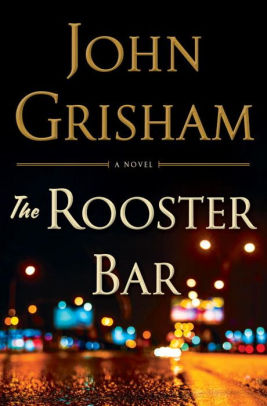
Title: The Rooster Bar
Author: John Grisham
Call #: FIC GRI
Click here for synopsis and reviews

Title: The Rooster Bar
Author: John Grisham
Call #: FIC GRI
Click here for synopsis and reviews
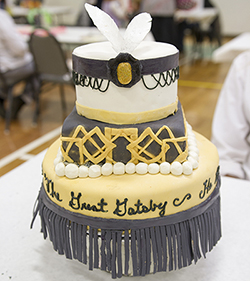
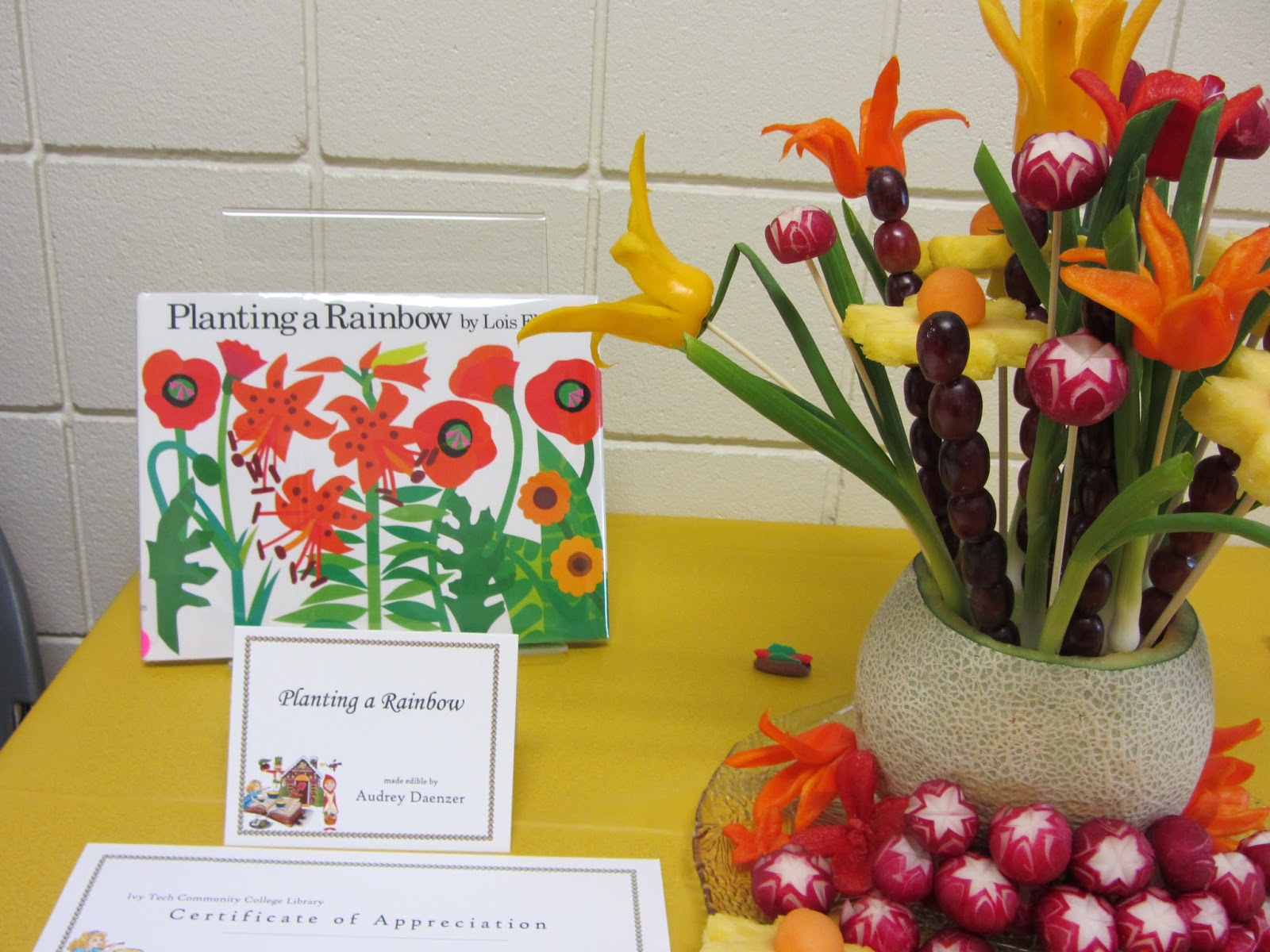
If you were on campus on Monday, April 4th, we hope you had enough time to stop by the Student Life Center and sample all of the wonderful culinary and literary creations at the 10th Annual Edible Book Festival. This event, hosted by the Ivy Tech Northeast Library, brings together students, staff, community members, and local businesses to showcase their edible interpretations of their favorite books. This year’s celebration featured 20 unique creations and brought in 200 attendees.
This year’s edible books covered a wide range of literary favorites, including The Lord of the Rings, Hitchhiker’s Guide to the Galaxy, and The Great Gatsby. Children’s stories were also well represented with delicious renditions of Winnie the Pooh, Chicka Chicka Boom Boom, and The Lorax, as well as some lesser-known children’s tales such as Mean Soup, Creepy Carrots, and Hold the Anchovies! Some participants really flexed their creative muscles by adapting works that aren’t normally associated with food into delicious dishes, such as the Emancipation Proclamation, The Haunted Mesa by Louis L’Amour, and Online Gambling and Crime, an academic text about the controversies involving the online gambling industry. Leave it to a librarian to come up with that last one.
When it comes to edible books, the flavors are just as important as the stories, and this year did not disappoint. Attendees were treated to Edible Books comprised of pizza, barbecue ribs, burritos, soup, and popcorn on the savory side of things. As always, dessert creations were also plentiful, with cookies and cakes coming in flavors from vanilla and chocolate to caramel marble, peach ginger, and oatmeal-carrot.
This year’s Edible Book Festival also featured a performance from professional storyteller Lou Ann Homan whose wonderful narrative flair entertained both children and adults. There was also a craft station where children and their families could make food-based necklaces with a charm representing a well-loved book. Not to leave any sense neglected, the soundtrack to this year’s festivities was an eclectic mix of songs from films that were inspired by literary works.
The winning edible books were selected based on audience voting, and this year’s winners were an impressive bunch. The first place winner was Ivy Tech student, Claudia Hollinger, with an edible book based on Harry Potter and the Sorcerer’s Stone by J.K. Rowling. Second place was taken by community member, Cayla Veach, with her creation based on Just You and Me by Sam McBratney. Taking third place was Ivy Tech student, Adrienne Cottrell, with her entry based on The Great Gatsby by F. Scott Fitzgerald. These three talented participants took the prizes this year, but each entry showed artistic skill and creative thinking. It’s never too early to start thinking about how you can take the top prize next year!
If you didn’t make it out to the 2016 event, be sure to check out the coverage on our local NPR station< WBOI, as well as the story that ran on local Fox affiliate WFFT. The Journal Gazette was also present to cover the event. As always, if you need a good book, or inspiration for your own delicious dishes, stop by the library and browse our collection today!
(By Library Clerk, David Winn)
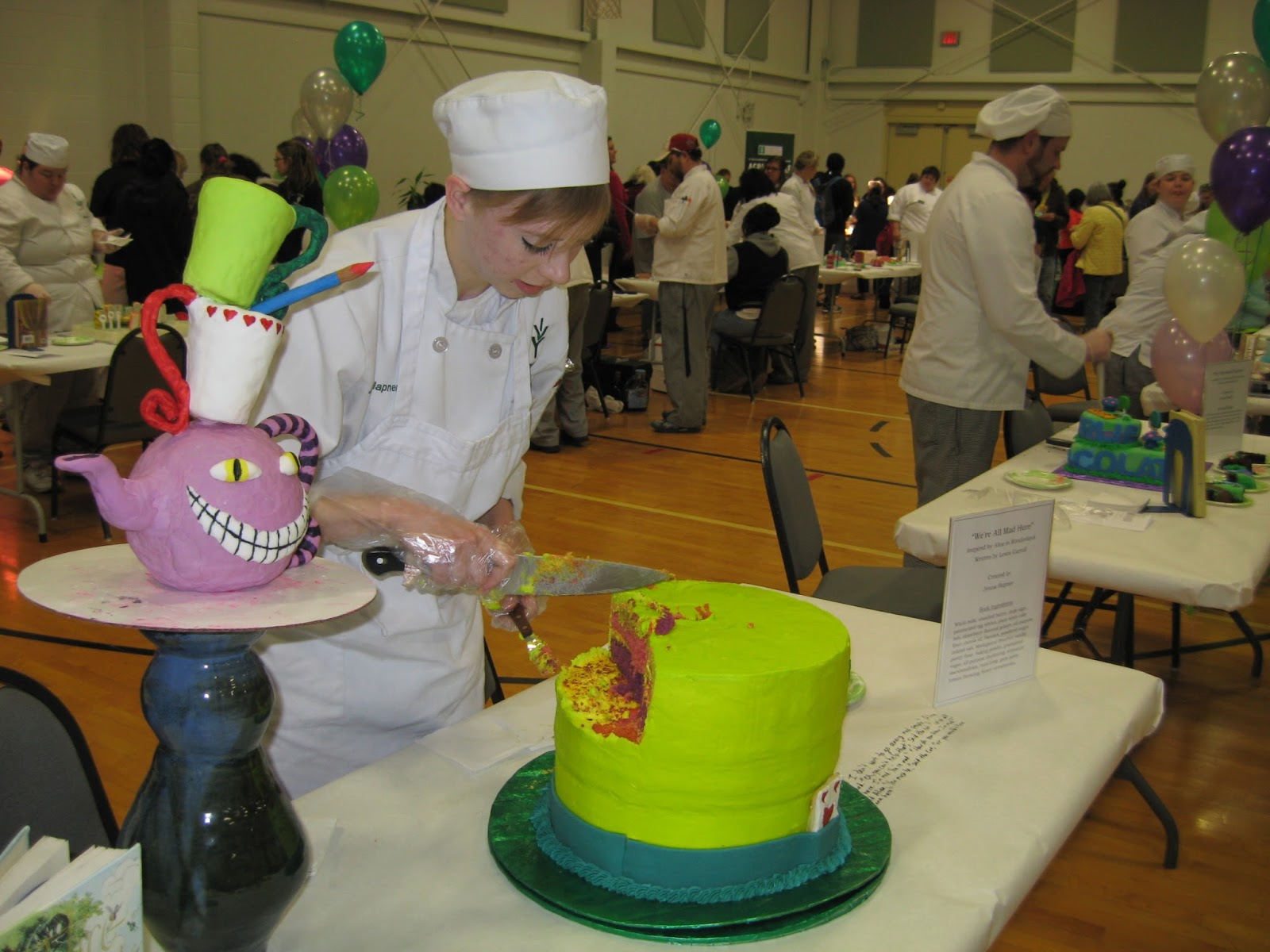
As March brings the fragrant flowers and singing birds of spring ever closer, here at the Ivy Tech Northeast Library we are gearing up for the delicious annual event that is The Edible Book Festival. This year’s festival marks the 10th time that we’ve held this event. We hope for it to be the most successful yet with crafts, prizes, a performance from storyteller Lou Ann Homan, and, of course, all of the fun, creative, and scrumptious dishes that the entrants have put together. For more details, information on how to enter, suggestions for books that may help with constructing a decorative dish, and to view photos of previous years’ Edible Books, click here.
We love that the flavors of Edible Book Festival bring everybody together, and sharing culinary works is a unique way to make books come to life, but let’s take a moment to focus on the other element that makes the Edible Book Festival possible—-the books! The dishes that participants create are a unique way to engage with literature. Another way to engage with your favorite literature, with the help of the Ivy Tech Northeast Library, is with the Bloom’s Literary Reference Online Database.

Based on the canon of famed literary critic Harold Bloom, Bloom’s Literary Reference Online is a collection of author biographies, synopses of works, and articles of literary criticism. There are also a host of pieces that trace themes across different works of literature. This is an invaluable tool for delving deeper into a piece of literature, whether for an assignment or your own personal interest. You may also have some luck with gathering ideas for an edible book. Allow me to demonstrate.

I’m a fan of the works of Edgar Alan Poe, but I’m not sure which one of his works would best translate into a food dish. Luckily, I can use the Bloom’s database to quickly browse synopses of his works. I simply search by author, and once I am on the page of articles related to Poe’s work, I start to browse the “Overviews and Synopses” tab for stories that sound like they may inspire an edible book. One that catches my eye is the story “Bon-Bon.” The story focuses on a French chef named Pierre Bon-Bon who is a lover of philosophy and wine, apparently too ardently on the second count. He is also renowned for his omelets. The story involves a conversation that he has with the devil himself, who, in Poe’s rendition of dark humor, relates that he has tasted the souls of many great men. Bon-Bon then tries to make a bargain with the devil by offering his own soul, and the devil refuses on the grounds that Bon-Bon has become unconscionably drunk over the course of their conversation.

This gave me a few ideas for edible interpretations of this story. The first that popped into my mind was deviled eggs. Chef Bon’s Bon’s deviled eggs would be a great way to combine that mention of Bon-Bon’s famous omelets with a devilish twist. I even found a recipe online that used a little curry powder and cumin to add some spice and a garnish for each egg with a slice of red grape, which you could use as a reference to the chef’s favorite drink. If I was feeling a little bit more daring, I could make chocolate bon-bons and then decorate them with the faces or names of the philosophers mentioned in the story, a way to reference the devil tasting the souls of the great thinkers. This is just an example, but hopefully it goes to show that there are creative ways to make a dish out of a story with just a little interpretation. You also don’t need to be a master in the kitchen to put together a fun display.
I encourage you all to give Bloom’s Literary Reference Online a look and to tuck it into the back of your mind if you ever need a resource for analyzing a story. It is just one of many places to look for inspiration in creating your own edible book, and we encourage everyone who is interested to fill out an entry form and join us to show off and share your creation. Even if you don’t feel like sharing your culinary skills, please join in the festivities at 12pm on April 4th. We hope to see you there!(By Library Clerk, David Winn)

As we make our way toward the tail-end of this rather mild winter, you may find yourself celebrating Valentine’s Day. For different couples, this day has various associations. Perhaps it’s an excuse for a romantic getaway. Maybe it’s a vibrant bouquet of flowers to dispel the winter’s dreariness. Or, if you’re anything like me, it’s all about the chocolate. Is it any wonder that we give this delicious, unique, and versatile treat away as a sign of our affection? Let’s dig a bit deeper into the world of chocolate, using the resources available in the Ivy Tech Northeast Library, to help understand what makes this confection so special.
A world without chocolate sounds like a dark place, but depending on where your ancestors hail from, that may have been the case. Made from the seeds of the cacao tree, chocolate was known for centuries as a treat, usually in the form of a drink, to Central American civilizations such as the Maya and the Aztecs. While we have come to associate the food with chocolatiers from Switzerland or Belgium, chocolate didn’t hit European shores until the Spanish conquistador Cortés encountered it during his New World exploration in the 16th century. As this Modern Marvels segment, available from the Films on Demand database, points out, chocolate as we know really came to be in 1828 when Dutch chocolate maker C.J. Van Houten created a press that allowed for the processing of cacao seeds into a dry powder, which in turn allowed in to be pressed into bars or baked into all the delectable treats we know it for today.

Since this development, the uses for chocolate have become many and varied, from the simplest bite-sized chocolate bar to the most elaborate cakes and pastries. The book Chocolate Passion from Tish Boyle and Timothy Moriarty is chock-full of “choc”-full recipes that feature the ingredient in delightful ways. For something relatively simple, the “Pain au Chocolat” is the perfect treat. The light, flaky croissant crust is the perfect way to deliver a rich, melted chocolate filling. If you’re feeling a bit more daring, try the unique fusion of flavors in “Ganache-filled Fried Wontons with Ginger Ice Cream and Chocolate Sorbet.” This recipe teaches you how to make everything, from the ice cream itself made with fresh ginger, to the ganache filling with bittersweet chocolate and cognac. The “Asian-spiced Dipping Sauce,” with its cinnamon, cloves, and anise is a perfect example of the many flavors that can complement and enhance your chocolate eating experience.

If you’re looking for something solely chocolate-focused, try Lisa Yockelson’s “Chocolate Savannahs, Remodeled” from her appropriately Chocolate Chocolate. As Yockelson describes, “The intense flavor reaches a chocolatey plateau in the dough through use of cocoa powder, bittersweet chocolate, unsweetened chocolate, and chocolate chips in the dough.” I’ll take a dozen.
Are you a diagnosed chocaholic? Ok, that may be a made-up condition, but our curiosity about chocolate from a health standpoint is definitely real. From the MedlinePlus database, an article from the National Institutes of Health entitled “Claims about Cocoa: Can Chocolate Really Be Good for You?” explores the various health claims about chocolate and its place in our diet. It details an interesting study about the Kuna people off the coast of Panama whose low risk of cardiovascular disease and blood pressure was found to be inconsistent with their salt intake and weight. Could this be good genetics? Not likely. The article also states that “those who moved away from the Kuna islands developed high blood pressure and heart disease at typical rate.” One unique aspect of their diet that piqued the interest of researchers was the fact that, as Dr. Brent M. Egan said, the amount of cocoa they consume “was easily 10 times more than most of us would get in a typical day.” Of course, this doesn’t mean you should stock up on Hershey’s bars for daily consumption. The Kuna’s chocolate is much closer to the original way that humans consumed it, a drink made from crushed and dried cacao pods that we would probably find much too bitter. Some researchers have tried to find links between chocolate and preventing disease such as diabetes or cancer, but it’s difficult to determine correlation with something as complex as diet, and almost impossible to declare causation. Even if chocolate helps stave off diabetes, most of the chocolate we eat as Americans is delivered in a way that is high in sugar and fat, which almost certainly does more harm than good. Going with darker, less processed chocolates—ideally paired with healthy foods such as fruits and nuts—seems to be the way to go. This is because a compound called flavonols are thought to be responsible for the health benefits of chocolate. Often flavonols, along with the more bitter taste that accompanies them, are removed the more cocoa is processed. By the time that cocoa makes its way into your slice of triple chocolate cheesecake, you probably shouldn’t consider it a health food. We haven’t yet reached a consensus on exactly what the health benefits of chocolate are, but as long as you’re watching the sugar and fat that accompany it, you may very well be doing your body a favor.
Are you going to enjoy any chocolate this month? There’s no wrong way to do so, and with so many interesting flavor combinations, you’ll never run out of interesting and flavorful ways to try this delicious ingredient. If you need more ideas about how to get more chocolate in your life, make sure to stop by the Ivy Tech Northeast Library and get inspired. (By Library Clerk, David Winn)

As we rush headlong into the spring 2016 semester, we begin a campus-wide focus on promoting values to improve Ivy Tech as a place to work and grow. To start off the year, we will be focusing on, as Jane Janovyak of Change Action Northeast puts it, “civility and the traits of being neighborly and encouraging.” Let’s take a few moments to think of what civility means here at Ivy Tech, and what we can all do to promote this value.
First things first: just what is civility? We seem to recognize right away when someone is being uncivil, but it can be harder to narrow down exactly what embodies this big concept. P. M. Forni, the author of Choosing Civility: The Twenty-Five Rules for Considerate Conduct defines civility by four qualities which it satisfies:
-Civility is complex
-Civility is good
-Whatever civility might be, it has to do with courtesy, politeness, and good manners
-Civility belongs in the realm of ethics
When reading more about Forni’s thoughts on civility, it becomes clear that this big idea of civility is not simply a checklist of dos and don’ts, or a handful of behaviors to adopt. The actions and behaviors of people who practice civility are certainly something to discuss and emulate, but the broader sense is that civility is about a constant sense of awareness about your own behavior and how it affects everything around you, both the people you interact with and the environment you inhabit. As Forni puts it, “Being civil means being constantly aware of others and weaving restraint, respect, and considerations into the very fabric of this awareness.” Civility, then, is not merely avoiding things that are considered uncivil, but actively aspiring to be well mannered.
One excellent article that is especially germane to everyone here at Ivy Tech is Alexander Popovics’ “Civility on Community College Campuses: A Shared Responsibility.” This article is available through the Humanities International Complete database, a part of EBSCO, and was originally published in the College Student Journal. One interesting distinction that Popovics makes via author Judy Rootskool is the difference between etiquette and civility. Civility is the underlying respect that informs behaviors like good etiquette. Civility may start to seem like an abstract concept, floating out there in the æther, but Popovics is very practical about the process of improving campus civility. He queries, “So do actions speak louder than words when we speak of civility and respect? The correct answer is that words combined with actions speak the loudest. And we need to speak loudly.” Popovics speaks to the need for a campus-wide initiative to really improve the level of civility in campus interactions.
As much as we focus on promoting civility, the value of civility stands out the most when we are confronted by the lack of it. An article entitled “Tit for Tat? The Spiraling Effect of Incivility in the Workplace” that is available through JSTOR addresses the true dangers of allowing incivility to perpetuate. Though incivility can be as simple as not cleaning up after yourself, neglecting to say thank you, or adopting a brusque tone, it can lead to larger problems such as verbal aggression, violence, and other antisocial behavior. Another article that is available through Proquest shows a link between incivility in the workplace and a negative impact on productivity. From a psychological perspective, Paul Jiménez demonstrates in his article “Workplace Incivility and Its Effects on Value Congruence, Recovery-Stress-State and the Intention to Quit” that a lack of civility can cause employees to look for other work, and keeps employees from uniting around positive values. There are very real consequences to allowing incivility to perpetuate within the workplace, and this is all the more reason to foster civility in its place.
Have I been civil today? Was there a time when my behavior could have been seen as rude? Could I have done more to make everyone around me more comfortable? Civility is not something that can be switched on instantly, but it is something at which we can try to be a little better each day. If you have an interaction that you walk away from with that slight “off” feeling, take a moment to examine what could have gone better. Even if it was the result of someone acting uncivil toward you, was there anything you could have done to improve the situation? Most of all, talk with your coworkers. Improving civility is a collaborative project, and only by engaging with others can we truly make strides toward civility. Hopefully this has been something to keep in mind as we all strive to make Ivy Tech a better place to work, live, and learn. (By Library Clerk, David Winn)

October marks the observance of Celiac Awareness Month, an event to generate awareness about a serious and painful chronic condition that results from reaction to gliadin, a gluten protein found in wheat. Conservative estimates show that at least 1 in 170 people have celiac disease, but it may also be under-diagnosed. Sufferers of celiac disease experience discomfort and pain in the digestive tract, diarrhea and chronic constipation, anemia, fatigue, and trouble properly absorbing nutrients through the intestines. The only real treatment for celiac disease is a gluten-free diet, a tough but manageable feat, at least here in the U.S. The article Celiac Disease and Gluten-Free Diet through the Health and Wellness Resource Center is a good overview of other symptoms and dietary restrictions for those with celiac disease.
Gluten? That stuff is bad, right? Part of the reason for raising awareness is providing clarity for those who misunderstand the mechanisms of celiac and similar conditions, and it all boils down to that one little word. So, let’s talk about gluten.
Gluten is such a misunderstood term in America that some have even begun to poke fun at it. In the 2013 apocalyptic comedy film This Is the End, Seth Rogan and Jay Baruchel (playing themselves) are arguing about the benefits of a gluten-free diet. When Baruchel accuses Rogan of not even knowing what gluten is, Rogan responds, “Gluten is a vague term. It’s something that’s used to categorize things that are bad. You know, calories, that’s a gluten. Fat, that’s a gluten.” With the way that “gluten free” has been marketed as a buzzword, someone whose only exposure to the term from ad copy might conclude that it is a dangerous chemical that is being needlessly injected into food. Gluten is, in fact, a naturally occurring wheat protein that is so useful that we extract it and use it elsewhere in our foodstuffs for its ability to add structural integrity—chewiness, basically. So how does this naturally occurring chemical react so poorly with some people’s bodies?
Celiac disease is not just an extreme allergic reaction. In a gluten or wheat allergy (allergy to other proteins contained in wheat other than gluten), the body reacts in the same way as other food allergies. The symptoms, while painful, are a temporary result of the body’s immune system reacting against proteins that it has incorrectly deemed harmful to the body. Once the reactive food is no longer in the body and the immune response has subsided, there is no permanent damage to the body. In celiac disease, the enzyme tissue transglutaminase reacts with the tissue of the small intestine, creating histological changes in the cells of the digestive system, weakening them in a way that causes many of the disease’s painful symptoms well after the meal has passed through the digestive tract. You can read more about the mechanism in the article Celiac Disease from the Journal of Allergy and Clinical Immunology through Proquest. The reaction to the gluten, in the case of celiac sufferers, is literally changing the body chemistry of the person through continual reactions. Does that mean eating gluten will damage one’s digestive tract? Hopefully not. Celiac disease is a genetic condition, and we understand it to the point that we have identified the gene markers that determine celiac disease, and we can test for them to rule out other autoimmune and digestive conditions.
If one don’t have celiac disease or allergies to wheat or gluten, should one be eating wheat? The simple answer is, you’re probably fine, in moderation. However, there is some research that is starting to shed light on other problems of wheat consumption that, while intriguing, is incomplete. Let’s talk about the term “leaky gut,” more technically known as intestinal permeability. Technically this refers to the phenomenon where the gastrointestinal wall becomes more porous, allowing the absorption of molecules beyond the nutrients it is supposed to absorb. Gliadin, another wheat protein, can react with the zonulin in the gut wall in order to produce this effect. The sticking point seems to be under what conditions this effect actually takes place. One study (Possible Links between Intestinal Permeablity and Food Processing: A Potential Therapeutic Niche for Glutamine) available through PubMed Central concluded that many conditions can result in increased intestinal permeability, but in trying to find an association between ingredients such as gluten and these conditions, the researchers concluded that “We have attempted to illustrate how alimentary compounds induced via modern cooking, food conservation and food processing methods may be associated with these pathologies when (intestinal permeability) is increased. These associations are certainly largely unrecognized and not necessarily easy to identify.” Studies like this seem to be turning up similar results: there is enough sporadic correlation between gluten and intestinal permeability to warrant study, but no one has been able to link causation in any meaningful way. In fact, another study (Divergence of gut permeability and mucosal immune gene expression in two glutenassociated conditions: celiac disease and gluten sensitivity) which compared the increase of intestinal permeability in celiac patients and patients with non-celiac gluten sensitivity found that gluten sensitivity “is not associated with increased intestinal permeability.” So why are gluten free diets so popular without conclusive proof that gluten is harmful for those who aren’t sensitive to gluten?
Never underestimate the allure of a new dieting fad. Many of the diets which include a gluten-free focus will help people lose weight. However, this probably has more to do with the elimination of carbs, not just gluten. Due to the health conditions that can be aggravated by gluten, many savvy salesman have been quick to try and correlate unwarranted health benefits to a gluten-free diet. Some diets that are good for your health will be gluten free; switching to a gluten-free diet will not automatically be good for your health. Let’s illustrate this by looking at one effect of eating wheat that can affect you, regardless of sensitivity: wheat’s effect on the glycemic index (GI), a way of measuring blood sugar increase after eating. In his book Wheat Belly , William Davis points out that “whole wheat bread has a GI of 72, while plain table sugar has a GI of 59. In contrast, kidney beans have a GI of 51, grapefruit comes in at 25, while noncarbohydrate foods such as salmon and walnuts have GIs of essentially zero.” Put simply, this shows that consumed food is converted into glucose, a sugar that, while necessary for providing energy, will be converted into fat if it’s not used up. Clearly, wheat has the potential to create excess fat. Here’s the rub: all starches do. If a GI of 72 sounds scary, consider for a moment white rice (GI or 89), corn flakes (GI of 93), or a baked russet potato (GI of 111). (Glycemic index and glycemic load for 100+ foods) Maybe gluten is not the worst, huh?
Coincidentally, the “albatross around all of our necks” may be the same reason it’s so difficult for those with celiac disease to find an appropriate meal in our current food climate. Because gluten is such a useful ingredient, we end up using it—a lot. It’s in sauces and soups, candy, processed meats and seitan, and many other products. Gluten provides structure, and makes for much more appealing products in everything from visual appeal to mouth feel. Unfortunately, we are paying the price if we’re not burning all of the glucose that results from it. Thus, we can all benefit from watching the amount of wheat (and other starches) in our diets, and a big part of this is shirking processed foods in favor of whole ingredients. For people with celiac disease, allergies, and intolerances, books like the Complete Gluten-Free Cookbook: 150 Gluten-free, Lactose-free Recipes, Many with Egg-free Variations are an essential tool for maintaining health and not getting bored in the kitchen. For those who really want to cut their intake of carbs, try Real Life Paleo : 175 Gluten-free Recipes, Meal Ideas, and an Easy 3-phased Approach to Lose Weight & Gain Health. We should all be sympathetic to the lengths that people with conditions like celiac disease go to in order to ensure their meal is one they can eat, and perhaps we can take it as a cue that we should all put a little more thought into what we’re putting into our bodies.
If you think that you have celiac disease, see your doctor immediately. If you think you have allergies or sensitivities to gluten or anything else, consult your doctor. If you have concerns about gluten or anything else in food, certainly don’t take my word for it; ask the experts and look at good research. Scientists will continue to research the effects of gluten and all sorts of other food chemicals on the body, and one day we will know to a fuller extent the effects of wheat on the human body. I would be remiss if I didn’t mention that there are some very vocal proponents out there who tout all grains as the cause of anxiety, depression, Alzheimer’s, and many other conditions, but this goes against the medical consensus of those who readily admit that while reducing carbs can help with certain neurological disorders, it is quite a leap to conclude that they caused them in the first place. For the time being, though, barring any medical conditions that make wheat the wrong choice for you, you can have that sandwich on whole wheat bread every once in a while. Just make some time for exercise too.
(By Library Clerk, David Winn)
Yar har, mateys! Grab your favorite parrot, a tricorn hat, and set your Facebook to pirate English (really, look in the language settings), because each September marks Talk Like a Pirate Day. You’ll find learning about these swashbucklers considerably less dangerous than trying to deliver cargo across the seas.
If you want to know about the quintessential pirate that came to define how pirates are portrayed in film, television, and literature, you have to go with Edward Teach, or Edward Thatch, as some knew him. Oh, you might know him as Blackbeard. According to an article in American Heritage which is accessible through Academic Search Premier Database in the Library, Blackbeard and his infamous ship the Queen Anne’s Revenge frequented not only the tropical islands of the Caribbean, but the waters of the Carolinas as well where his prized frigate was eventually run aground.
If you already know about Blackbeard’s legacy, perhaps you’d like to hear about some of the women who made their fortune on the high seas. Hop onto the Library’s JSTOR database to read an article from the Wilson Quarterly that describes the exploits of the Irishwoman Anne Bonny or Mary Read who, prior to her life of piracy, fought in the British military while disguised as a man.
Are you in a pirate mood yet? How about some sea shanties? This album by the Robert Shaw Chorale from the Library’s Naxos database has plenty of historical shanties that you might hear on the deck of a flagship so many years ago.
Now that we have you feeling like a pirate, we should also give a cautionary word that piracy is illegal. Nowadays, a pirate’s treasure is more likely to be illegal copies of films and music than gold doubloons, but we recommend you avoid both types whether on the high seas or behind the keyboard. If you want to know more about the new age of piracy, try this article from the Harvard International Review, accessible through GALE database:
The golden age of piracy: can open-source democracy redefine citizenship for the internet age?
Piracy on the high seas still exists as well, though the environs have changed. Somali pirates are still a major threat around the Horn of Africa where large cargo container ships are slow-moving targets. You can see a dramatized account of one such pirate attack in the film Captain Phillips. You can also check out this excerpt from the documentary Madagascar to the Seychelles: Indian Ocean, with Simon Reeve which is available through Library’s Films on Demand database.
Well, this has all gotten a bit too serious, hasn’t it? Talk Like a Pirate Day is all about having fun with the campy, swashbuckling antiheroes that pop up everywhere from Peter Pan to Robinson Crusoe. If you need help talking like a pirate, we have you covered. Mango Languages database, an excellent online language learning program that is set up to teach over 60 languages has a module specifically for learning to talk like a pirate. Get out there and have a swashbuckling good time this September.
(By the Library Clerk, David Winn)
By Library Clerk, David Winn
We all know the name Harper Lee. Whether it was from reading her luminary novel To Kill a Mockingbird or from watching the fantastic film adaptation starring Gregory Peck from 1962, the characters Harper Lee created based on her own experience growing up in racially discordant Monroeville, Alabama have struck a chord with many personally and in the American consciousness. When it was announced earlier this year that Go Set a Watchman, Lee’s second novel was to be released, many were no doubt surprised to learn that Lee was still alive despite having not published anything in the previous five decades, due in no small part to her cherished reclusiveness. Funnily enough, this “new” novel is not so new at all—Lee wrote this story, set chronologically after To Kill a Mockingbird, before her masterpiece was even started. Her editor urged her to table the text for time being and try writing something from young Scout’s perspective, a decision which inadvertently spurred on the creation of a treasured classic. Early reactions from those who have read the manuscript indicate that Lee has another brilliant work to her credit now, but there is no shame in living as a literary one-hit wonder. She certainly is not the first, and as history goes to show, sometimes all you need is one powerful work to guarantee you will never be forgotten.
Emily Brontë published Wuthering Heights in 1847 before passing from consumption within a year’s time. This gothic tale of unrequited love and madness set on the windswept fields of northern England has been a staple of Victorian literature, and later an example of classic romance in somewhat more straightforward film adaptations. People tend to refer to the Brontë sisters as a collective, but each of the women’s work contain characteristics all their own, which makes it all the more disappointing that Emily wasn’t able to complete a second major work.
Ralph Ellison’s only released one novel, Invisible Man in 1952. There was no tragic death to cut short Ellison’s career as a novelist; he was a prolific writer, as exhibited in several collections of essays that were published in his fifty-year career. In some ways, Invisible Man distills everything Ellison critiqued about the African American experience, inspired by the prejudices he faced as a black man in America, imagined through the eyes of a man who had been driven underground (literally) and made invisible by a society that refused to acknowledge him. While his essays gave him a shorter, more direct form to level social critique, he nevertheless tried to draft a second novel. After a catastrophic house fire consumed the manuscript he had started in 1967, he tried for the remainder of his career to craft a second novel he felt was up to snuff. He left over 2,000 pages after his death which have been edited and released in different forms, but never with the singular, complete power of Invisible Man.
While a bulk of his work is comprised of short stories and novellas, J.D. Salinger is another author whose name stands out because of the popularity of his single novel, A Catcher in the Rye. This seminal work of teenage alienation has become as widely read as it is challenged, still being one of the books most targeted by concerned parents for banning in schools. Salinger continued to write after the novel’s publication in 1951, but he soon grew fond of a life of reclusion, and ceased publishing anything after a final novella in 1965. It may surprise you then, that Salinger passed away in 2010 at age 91, having not given any interviews for three decades.
Which bring us back to Harper Lee, or Nell as she was known to close friends, such as true crime author Truman Capote. While making rare appearances to receive accolades and the occasional written letter that garnered press, Lee has certainly maintained privacy despite her novel’s success. She also abandoned her only attempt at writing a novel in the years after To Kill a Mockingbird, going so far as to declare that we would never see another from her. Hopefully with the release of Go Set a Watchman, everyone will get what they want. For the readers, another story from this brilliant writer featuring characters we already love, and for Harper Lee, the peace of mind that comes with taking care of unfinished business.

Ivy Tech is comprised of a very diverse group of students from all walks of life, but you will find one attribute that ties all of them together—we are a community of career-focused learners. Whether gaining a skillset to enter the workforce for the first time, or continuing education in order to advance in the field, goal-oriented students are as much concerned about what comes next in their career as which assignments are due the next day. Ferguson’s Career Guidance Center is an excellent choice for obtaining information to help students make the right career choices and keep them motivated.
Ferguson’s Career Guidance Center features nearly every aspect of planning for and starting a career. The database has a number of articles that feature “Job Profiles” which feature detailed overviews of an occupation These include a detailed job description, the levels of education and certification required, the range of salary, and the outlook for the occupation going forward. Ferguson’s Career Guidance Center can also help with educational goals toward a career with features that help you to plan out your college timeline, show the occupational possibility of different degree programs, and even a provide a comprehensive list of internship and work-study programs for those who want to start their work experience while still in school. When it comes time to actually enter the work force, Ferguson’s also has you covered. The database features articles on how to create the perfect resume, methods for more effective networking, and how to ace a job interview. You can even search job postings by location or type of position.
How to best use Ferguson’s database varies widely by which point in education and career you find yourself, but suffice it to say, there is something helpful for everyone. A student who is considering the field of nursing might take a look at the Registered Nurse job profile and start to plan the educational path he or she will have to take, as well as what to expect from the day-to-day work as a registered nurse. Perhaps a business student is far along in their education and wants to pick up some practical skills through work experience. By clicking the “Business” category under “Resources by Industry,” they are presented with a whole list of internships that are tailored to aspiring business students. Maybe a student has reached the end of their culinary program and is ready to apply their newfound skills to a job, but is worried their resume is too weak. They can browse a whole host of articles tailored to improving cover letters and resumes, including this article which details ways to better pitch oneself to a prospective employer.
Success requires planning, and having the resources to do that planning in one place is an invaluable asset. Ferguson’s Career Guidance Center has what motivated students need to find the right career path and how to stay on that path they achieve their career goals.
By Library Clerk, David Winn
Global Road Warrior is a fantastic resource for getting all the information you would want about a country, but in an easily digestible form. While there is plenty of useful information for those who plan on traveling to a foreign country, there are also a multitude of facts that can help in any paper or project. Global Road Warrior lists everything from basic facts about a country’s geography, history, and demographics to more detailed sociological aspects such as the structure of their education system, common national recipes, religious beliefs, and how women are treated in business and culture. For each of the over 150 countries listed, Global Road Warrior provides a snapshot of a foreign culture that helps to better understand life in that country.
Imagine for a moment that you wanted to write a paper that examines the way governments are structured in various Eastern European countries. Taking Belarus for example, we can see a whole host of information including when the people achieved independence and drafted their constitution, what sort of legal system the government operates under, and what offices comprise the three branches of government, as well as the names of major representatives.
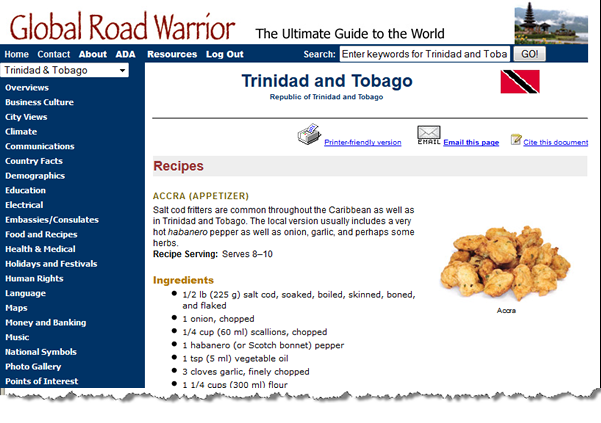
Perhaps you are a culinary student who wants to know what sort of Caribbean recipes you could add to your repertoire. By looking into the Trinidad and Tobago page, you can get a quick description of which culinary traditions came to influence this country’s cuisine, as well as several recipes for how to prepare them. You now have everything you need to fix a batch of accra, salted cod fritters seasoned with onion, hot peppers, and chives, or perhaps sancoche, a stew containing yams, tannia, eddoes, taro, cassava, bananas, potatoes, pumpkin, and plantains.
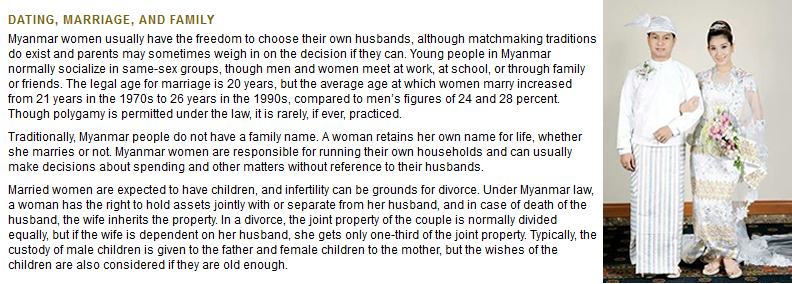
Maybe you find yourself working with a local organization that helps Burmese immigrants that have left Myanmar. You want to get a better picture of their culture, specifically about how the culture views women. The Global Road Warrior page for Myanmar gives details about marriage traditions, including the fact that family names are not common and that a married woman will keep her own surname. You learn that women typically run the household, and they are able to choose who they marry as well as initiate divorce. It is not uncommon for Burmese women to work, especially in the field of teaching or nursing, but if this is the case, she still maintains the household or the responsibility falls on the maternal grandmother. You can see how knowing these dynamics could help when learning how to understand the day-to-day concerns of a Burmese family who has immigrated to the United States.
These are just a few examples, but you can see how Global Road Warrior surfaces droves of useful information about nearly anywhere in the world with just a few clicks. It should also be noted that for anyone who plans on traveling, the sections that detail which immunizations get, general safety concerns, and contact information for embassies and consulates in foreign countries are a must-have for the prepared traveler. Any time you have a project that involves another culture, country, or even our own demographics here in the U.S., remember that you can access Global Road Warrior through the Ivy Tech Northeast Library. (By Library Clerk, David Winn)




 Fort Wayne & Warsaw Library Blogs