
Start something that matters / Blake Mycoskie

Call number: HF5414 .M93 2012

Why this book is for you:
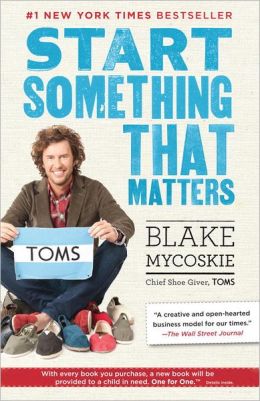
  • You’re ready to make a difference in the world—through your own start-up business, a nonprofit organization, or a new project that you create within your current job
  • You want to love your work, work for what you love, and have a positive impact on the world—all at the same time.
  • You’re inspired by charity: water, method, and FEED Projects and want to learn how these organizations got their start. 
  • You’re curious about how someone who never made a pair of shoes, attended fashion school, or worked in retail created one of the fastest-growing footwear companies in the world by giving shoes away. 
  • You’re looking for a new model of success to share with your children, students, co-workers, and members of your community.(From Google Books)
Ninety percent of everything : inside shipping, the invisible industry that puts clothes on your back, gas in your car, and food on your plate / Rose George

Call number: HE571 .G465 2013

On ship-tracking websites, the waters are black with dots. Each dot is a ship; each ship is laden with boxes; each box is laden with goods. In postindustrial economies, we no longer produce but buy. We buy, so we must ship. Without shipping there would be no clothes, food, paper, or fuel. Without all those dots, the world would not work.
Freight shipping has been no less revolutionary than the printing press or the Internet, yet it is all but invisible. Away from public scrutiny, shipping revels in suspect practices, dubious operators, and a shady system of “flags of convenience.” Infesting our waters, poisoning our air, and a prime culprit of acoustic pollution, shipping is environmentally indefensible. And then there are the pirates.
Rose George, acclaimed chronicler of what we would rather ignore, sails from Rotterdam to Suez to Singapore on ships the length of football fields and the height of Niagara Falls; she patrols the Indian Ocean with an anti-piracy task force; she joins seafaring chaplains, and investigates the harm that ships inflict on endangered whales.
Sharply informative and entertaining, Ninety Percent of Everything reveals the workings and perils of an unseen world that holds the key to our economy, our environment, and our very civilization. (From Google Books)
 

Learning to be old : gender, culture, and aging / Margaret Cruikshank

Call number: BF724.55.A35 C78 2013

Margaret Cruikshank’s Learning to Be Old examines what it means to grow old in America today. The book questions social myths and fears about aging, sickness, and the other social roles of the elderly, the over-medicalization of many older people, and ageism. In this book, Cruikshank proposes alternatives to the ways aging is usually understood in both popular culture and mainstream gerontology. Learning to Be Old does not propose the ideas of successful aging or productive aging, but more the idea of learning how to age. Featuring new research and analysis, the third edition of Learning to be Old demonstrates, more thoroughly than the previous editions, that aging is socially constructed. Among texts on aging the book is unique in its clear focus on the differences in aging for women and men, as well as for people in different socioeconomic groups. Cruikshank is able to put aging in a broad context that not only focuses on how aging affects women but men, as well. Key updates in the third edition include changes in the health care system, changes in how long older Americans are working especially given the impact of the recession, and new material on the brain and mind-body interconnections. Cruikshank impressively challenges conventional ideas about aging in this third edition of Learning to be Old. This will be a must-read for everyone interested in new ideas surrounding aging in America today. (From Google Books)