
Happy Birthday USA!

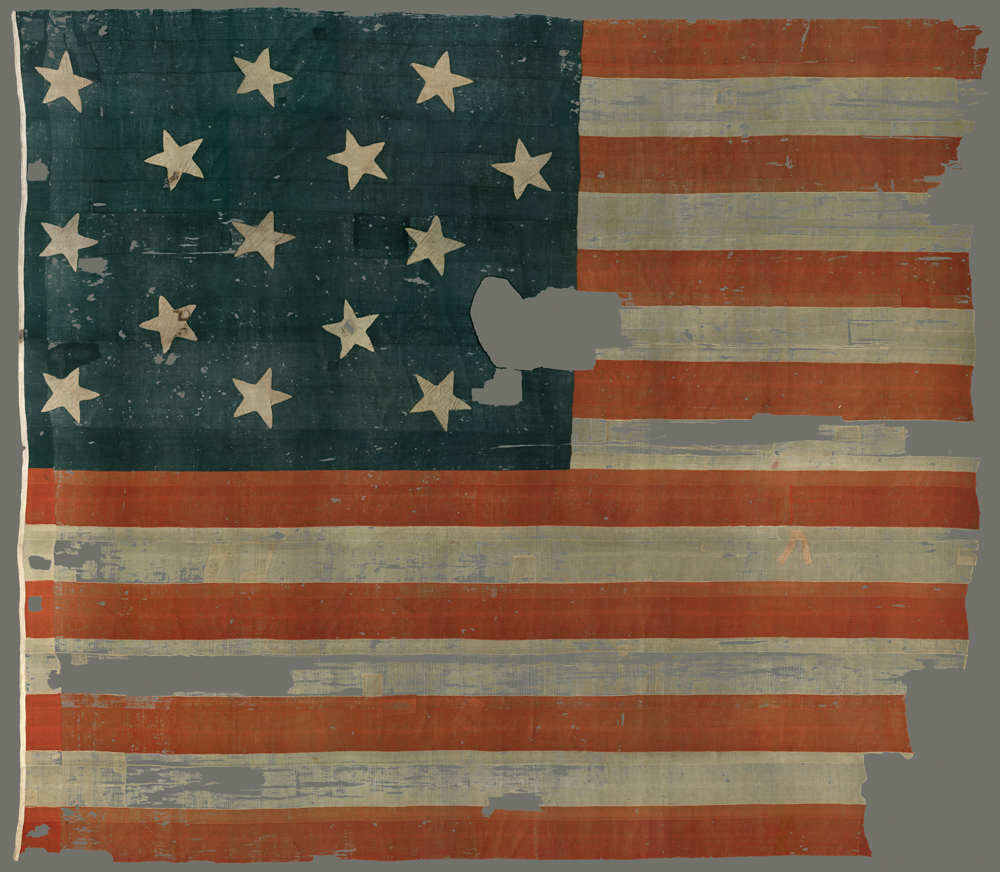
The flag that inspired “The Star-Spangled Banner” (image from the Smithsonian Institution


While fireworks explode as we celebrate the Fourth of July, you can get a blast from the past with these great historical resources! Who isn’t moved by examining Thomas Jefferson’s handwritten draft of the Declaration of Independence, or reading manuscript letters of George Washington, or the reports of eyewitnesses to battles in the Revolution?
The Coming of the American Revolution is a freely accessible, online gallery from the Massachusetts Historical Society containing digitized primary source documents like broadsides and newspaper announcements of meetings of the Sons of Liberty. Documents are presented with extensive scholarly notes and resources for teachers and students. It is clearly organized and offers multiple searching options.
Examine three early versions of the Declaration of Independence in the online gallery of the American Philosophical Society in Philadelphia. The first is Jefferson’s draft, which he sent to a friend before submitting it to the Continental Congress on July 1st, 1776.
Examine correspondence between members of the Continental Congress, digitized by The New York Public Library’s Early American Manuscripts Project. These collections include hand-written letters cross-indexed by names and topics. Keyword searching will find these tags.
Read transcribed accounts of battles from eyewitnesses and soldiers’ diaries of life in the Continental Army in the database American History Online accessible through the Ivy Tech Northeast Library home page. Find it in the A-Z list of databases. From the American History Home page, under “Browse Resources” choose “Primary Sources,” then under “Filter Primary Sources” choose “American Revolution” to see an index of transcriptions. This database also has maps of major battles in the War of Independence. From the Home page, under “Browse Resources” choose “Maps and Charts”, then under “Filter Maps and Charts” choose “American Revolution.”
What was life like in the Federal period after the Revolution? Check out the open database Chronicling America: Historic American Newspapers. Papers from 1789-1924 are keyword-searchable. 1876 was the centennial year of the United States. To see newspaper articles about the celebrations, do an advanced searchof all states for the phrase centennial anniversary or centennial celebration. Choose the date range 1870-1880 for articles about the preparation and aftermath. This is an ongoing project of the National Endowment for the Humanities, coordinated by the Library of Congress. Content is being contributed by local institutions, digitized in a format suitable for keyword searching. This site also provides a directory of newspapers from 1690-present, showing library holdings; this is the expected range of coverage upon completion.
Are you decorating your house for the holiday? Symbols of the United States is a Primary Source Set from the Library of Congress, written for elementary schools but fun for all. View digitized original sources and read the history of the Liberty Bell, our flag, the bald eagle, Uncle Sam, the Star Spangled Banner, and the Statue of Liberty. This set includes a Teachers’ plan, a student guide, and a free ebook for iOS devices.

Summer Reading

person reading under tree with dog sleeping at side

Summer term is shorter than Fall and Spring, and classes can be intense! We are all grateful for the breaks between semesters. This is the perfect time to read a book just for fun – no citations, annotations, or discussion post required! I asked our staff for reading recommendations, suggesting a classic and a recently published book.

Elizabeth Metz (Librarian): I just finished Norse Mythology by Neil Gaiman, it was excellent (but then I’m biased towards his works!). It is available to borrow in our Baker & Taylor collection. My second book, it’s not a classic per se, but it’s one of my all-time favorites: The Hitchhiker’s Guide to the Galaxy by Douglas Adams. This is available in our Fiction collection.

Elina Puckett (evening librarian): Summer is not exactly the time to think about cold and ice, yet two books – The Way of the Iceman by Wim Hof and What Doesn’t Kill Us on cold training may significantly improve your summer by teaching you how to “dramatically enhance energy levels, improve circulation, reduce stress, boost the immune system, strengthen the body and successfully combat many disease.”

Ann Spinney (afternoon librarian): A classic summer book for me is Ulysses by James Joyce, a story about a man going about his day on June 16th, 1904 worrying about his wife’s infidelity. Obviously, this is not a book for kids! Joyce was an accomplished singer and the book is full of the sounds of Dublin in summer; it is a wonderful book to read aloud. It is based on the classical story of Ulysses the mariner, with events that are parallel: for example, the Cyclops monster of the original is a racist man holding forth in a pub in Joyce’s retelling. The book is available to borrow in our fiction collection.
A new book I am recommending is Taduno’s Song by Odafe Otogun. It also is based on a classical story, the myth of Orpheus the musician who tries to rescue his wife from Hades. Otogun’s retelling is based in modern Nigeria. His writing sparkles with the precision of poetry. I could not put this book down and read it twice over, it is so enchanting, sad, and beautiful. We have it available to borrow in our Baker & Taylor collection.

Carol Gibbs (library assistant/ILL): Carol recommended a series of fiction books by Sarah Addison Allen, all set in rural North Carolina and centering around family mysteries. Several are available in our fiction collection.

Diana Dudley (library assistant): Diana submitted a long list, so feel free to ask her for more recommendations! She included The Three Musketeers by Alexandre Dumas as her classic read; and City of Light, City of Poison: Murder, Magic, and the First Police Chief of Paris by Holly Tucker, which is a new nonfiction book available to borrow in our Baker & Taylor collection.

Jean Adkins (library assistant): My classic favorite is The Hobbit by J.R.R. Tolkien (in our fiction collection) and a new book that I enjoyed is Ghosts of War by Brad Taylor (in our Baker & Taylor collection).

Bridging the Soft Skills Gap

How to Teach the Missing Basics to Today’s Young Talent

9781118725641-usBy Bruce Tulgan
Call Number: HF5381 .T757 2015
View in IvyCat

The number one challenge with today’s young talent is a problem hiding in plain sight: the ever-widening soft skills gap. Today’s new, young workforce has so much to offer new technical skills, new ideas, new perspective, new energy. Yet too many of them are held back because of their weak soft skills. Soft skills may be harder to define and measure than hard skills, but they are just as critical. People get hired because of their hard skills but get fired because of their soft skills. Setting a good example or simply telling young workers they need to improve isn’t enough, nor is scolding them or pointing out their failings in an annual review. However you can teach the missing basics to today’s young talent. Based on more than twenty years of research, Bruce Tulgan, renowned expert on the millennial workforce, offers concrete solutions to help managers teach the missing basics of professionalism, critical thinking, and followership complete with ninety-two step-by-step lesson plans designed to be highly flexible and easy to use. Tulgan’s research and proven approach has show that the key to teaching young people the missing soft skills lies in breaking down critical soft skills into their component parts, concentrating on one small component at a time, with the help of a teaching-style manager. Almost all of the exercises can be done in less than an hour within a team meeting or an extended one-on-one. The exercises are easily modified and customized and can be used as take-home exercises for any individual or group, to guide one-on-one discussions with direct-reports and in the classroom as written exercises or group discussions. Managers and their young employees will find themselves returning to their favorite exercises over and over again. One exercise at a time, managers will build up the most important soft skills of their new, young talent. These critical soft skills can make the difference between mediocre and good, between good and great, between great and one of a kind.