Category Archives: Featured Materials

Deep Down: A Story from the Heart of Coal Country DVD

Call number: TD 195 .C58 D446 2010

Beverly May and Terry Ratliff grew up like kin on opposite sides of a mountain ridge in eastern Kentucky. Now in their fifties, the two find themselves in the midst of a debate dividing their community and the world: who controls, consumes, and benefits from our planet’s shrinking supply of natural resources? While Beverly organizes her neighbors and leads a legal fight to stop Miller Brothers Coal Company from advancing into her hollow, Terry considers signing away the mining rights to his backyard-a decision that could destroy not only the two friends’ homes, but the peace and environment surrounding their community. The two friends soon find themselves caught in the middle. of a contentious battle over energy and the wealth and environmental destruction it represents. Deep Down brings to light questions of our own morality, our connection to the earth’s resources, and most importantly… Written by Sally Rubin

Nuclear energy : what everyone needs to know / Charles D. Ferguson

Call number: TK9145 .F47 2011

Originally perceived as a cheap and plentiful source of power, the commercial use of nuclear energy has been controversial for decades. Worries about the dangers that nuclear plants and their radioactive waste posed to nearby communities grew over time, and plant construction in the United States virtually died after the early 1980s. The 1986 disaster at Chernobyl only reinforced nuclear power’s negative image. Yet in the decade prior to the Japanese nuclear crisis of 2011, sentiment about nuclear power underwent a marked change. The alarming acceleration of global warming due to the burning of fossil fuels and concern about dependence on foreign fuel has led policymakers, climate scientists, and energy experts to look once again at nuclear power as a source of energy. In this overview, the author provides an account of the key facts about nuclear energy. What is the origin of nuclear energy? What countries use commercial nuclear power, and how much electricity do they obtain from it? How can future nuclear power plants be made safer? What can countries do to protect their nuclear facilities from military attacks? How hazardous is radioactive waste? Is nuclear energy a renewable energy source? Featuring a discussion of the recent nuclear crisis in Japan and its ramifications, he addresses these questions and more.

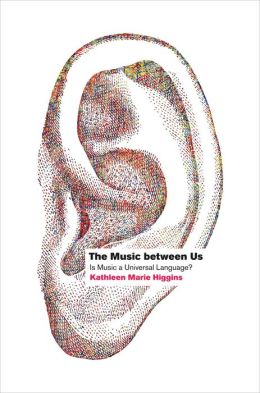
The music between us : is music a universal language? / Kathleen Marie Higgins

Call number: ML3916 .H54 2012

From our first social bonding as infants to the funeral rites that mark our passing, music plays an important role in our lives, bringing us closer to one another. In The Music between Us, philosopher Kathleen Marie Higgins investigates this role, examining the features of human perception that enable music’s uncanny ability to provoke, despite its myriad forms across continents and throughout centuries, the sense of a shared human experience. Drawing on disciplines such as philosophy, psychology, musicology, linguistics, and anthropology, Higgins’s richly researched study showcases the ways music is used in rituals, education, work, healing, and as a source of security and—perhaps most importantly—joy. By participating so integrally in such meaningful facets of society, Higgins argues, music situates itself as one of the most fundamental bridges between people, a truly cross-cultural form of communication that can create solidarity across political divides. Moving beyond the well-worn takes on music’s universality, The Music between Us provides a new understanding of what it means to be musical and, in turn, human. (From Google Books)

Hamas and civil society in Gaza : engaging the Islamist social sector / Sara Roy

Call number: HV6433.P25 R69 2011

“Many in the United States and Israel believe that Hamas is nothing but a terrorist organization, and that its social sector serves merely to recruit new supporters for its violent agenda. Based on Sara Roy’s extensive fieldwork in the Gaza Strip and West Bank during the critical period of the Oslo peace process, Hamas and Civil Society in Gaza shows how the social service activities sponsored by the Islamist group emphasized not political violence but rather community development and civic restoration. Roy demonstrates how Islamic social institutions in Gaza and the West Bank advocated a moderate approach to change that valued order and stability, not disorder and instability; were less dogmatically Islamic than is often assumed; and served people who had a range of political outlooks and no history of acting collectively in support of radical Islam.
These institutions attempted to create civic communities, not religious congregations. They reflected a deep commitment to stimulate a social, cultural, and moral renewal of the Muslim community, one couched not only–or even primarily–in religious terms. Vividly illustrating Hamas’s unrecognized potential for moderation, accommodation, and change, Hamas and Civil Society in Gaza also traces critical developments in Hamas’s social and political sectors through the Second Intifada to today, and offers an assessment of the current, more adverse situation in the occupied territories. The Oslo period held great promise that has since been squandered. This book argues for more enlightened policies by the United States and Israel, ones that reflect Hamas’s proven record of nonviolent community building”– “Unlike other books on Hamas this study examines Hamas’s social service sector with a focus on the Oslo period. It analyzes the nature of Islamist social sector activities, the successes and failures of Islamist social activism and mobilization and argues that the ethos of civic engagement that defined Hamas’s social sector acted as a viable and powerful alternative to militancy and political violence”

So rich, so poor : why it’s so hard to end poverty in America

Call number: HC110.P6 E34 2012

If the nation’s gross national income?over $14 trillion?were divided evenly across the entire U.S. population, every household could call itself middle class. Yet the income-level disparity in this country is now wider than at any point since the Great Depression. In 2010 the average salary for CEOs on the S&P 500 was over $1 million?climbing to over $11 million when all forms of compensation are accounted for?while the current median household income for African Americans is just over $32,000. How can some be so rich, while others are so poor?

In this provocative book, Peter Edelman, a former top aide to Senator Robert F. Kennedy and a lifelong antipoverty advocate, offers an informed analysis of how this country can be so wealthy yet have a steadily growing number of unemployed and working poor. According to Edelman, we have taken important positive steps without which 25 to 30 million more people would be poor, but poverty fluctuates with the business cycle. The structure of today’s economy has stultified wage growth for half of America’s workers?with even worse results at the bottom and for people of color?while bestowing billions on those at the top.

So Rich, So Poor delves into what is happening to the people behind the statistics and takes a particular look at the continuing crisis of young people of color, whose possibility of a productive life too often is lost on their way to adulthood. This is crucial reading for anyone who wants to understand the most critical American dilemma of the twenty-first century. (From Google Books)

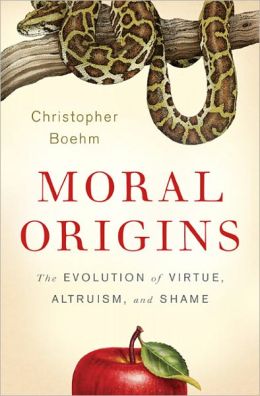
Moral origins : the evolution of virtue, altruism, and shame / Christopher Boehm

Call number: BJ1311 .B645 2012

From the age of Darwin to the present day, biologists have been grappling with the origins of our moral sense. Why, if the human instinct to survive and reproduce is “selfish,” do people engage in self-sacrifice, and even develop ideas like virtue and shame to justify that altruism? Many theories have been put forth, some emphasizing the role of nepotism, others emphasizing the advantages of reciprocation or group selection effects. But evolutionary anthropologist Christopher Boehm finds existing explanations lacking, and in Moral Origins, he offers an elegant new theory.

Tracing the development of altruism and group social control over 6 million years, Boehm argues that our moral sense is a sophisticated defense mechanism that enables individuals to survive and thrive in groups. One of the biggest risks of group living is the possibility of being punished for our misdeeds by those around us. Bullies, thieves, free-riders, and especially psychopaths—those who make it difficult for others to go about their lives—are the most likely to suffer this fate. Getting by requires getting along, and this social type of selection, Boehm shows, singles out altruists for survival. This selection pressure has been unique in shaping human nature, and it bred the first stirrings of conscience in the human species. Ultimately, it led to the fully developed sense of virtue and shame that we know today.A groundbreaking exploration of the evolution of human generosity and cooperation, Moral Origins offers profound insight into humanity’s moral past—and how it might shape our moral future. (From Google Books)

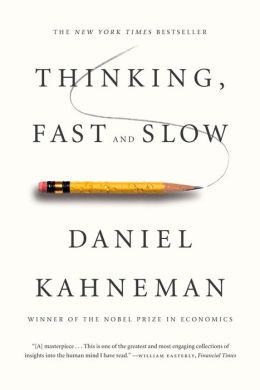
Thinking, fast and slow / Daniel Kahneman

Call number: BF441 .K238 2011


In this work the author, a recipient of the Nobel Prize in Economic Sciences for his seminal work in psychology that challenged the rational model of judgment and decision making, has brought together his many years of research and thinking in one book. He explains the two systems that drive the way we think. System 1 is fast, intuitive, and emotional; System 2 is slower, more deliberative, and more logical. He exposes the extraordinary capabilities, and also the faults and biases, of fast thinking, and reveals the pervasive influence of intuitive impressions on our thoughts and behavior. He reveals where we can and cannot trust our intuitions and how we can tap into the benefits of slow thinking. He offers practical and enlightening insights into how choices are made in both our business and our personal lives, and how we can use different techniques to guard against the mental glitches that often get us into trouble. This author’s work has transformed cognitive psychology and launched the new fields of behavioral economics and happiness studies. In this book, he takes us on a tour of the mind and explains the two systems that drive the way we think and the way we make choices.

The brain : big bangs, behaviors, and beliefs / Rob DeSalle

Call number: BF311 .D466 2012

After several million years of jostling for ecological space, only one survivor from a host of hominid species remains standing: us. Human beings are extraordinary creatures, and it is the unprecedented human brain that makes them so. In this delightfully accessible book, the authors present the first full, step-by-step account of the evolution of the brain and nervous system.
Tapping the very latest findings in evolutionary biology, neuroscience, and molecular biology, Rob DeSalle and Ian Tattersall explain how the cognitive gulf that separates us from all other living creatures could have occurred. They discuss the development and uniqueness of human consciousness, how human and nonhuman brains work, the roles of different nerve cells, the importance of memory and language in brain functions, and much more. Our brains, they conclude, are the product of a lengthy and supremely untidy history—an evolutionary process of many zigs and zags—that has accidentally resulted in a splendidly eccentric and creative product. (From Google Books)

CEH, Certified Ethical Hacker : exam guide : all-in-one / Matt Walker

Call number: QA76.3 .W3344 2012

Get complete coverage of all the objectives included on the EC-Council’s Certified Ethical Hacker exam inside this comprehensive resource. Written by an IT security expert, this authoritative guide covers the vendor-neutral CEH exam in full detail. You’ll find learning objectives at the beginning of each chapter, exam tips, practice exam questions, and in-depth explanations. Designed to help you pass the exam with ease, this definitive volume also serves as an essential on-the-job reference.
COVERS ALL EXAM TOPICS, INCLUDING:

  • Introduction to ethical hacking
  • Cryptography
  • Reconnaissance and footprinting
  • Network scanning
  • Enumeration
  • System hacking
  • Evasion techniques
  • Social engineering and physical security
  • Hacking web servers and applications
  • SQL injection
  • Viruses, trojans, and other attacks
  • Wireless hacking
  • Penetration testing

CD-ROM FEATURES:

  • Two practice exams
  • PDF copy of the book
  • Bonus appendix with author’s recommended tools, sites, and references

Matt Walker, CEHv7, CPTS, CNDA, CCNA, MCSE, has held a wide variety of IT security teaching, writing, and leadership roles, including director of the Network Training Center on Ramstein AB, Germany, and IT security manager for Lockheed Martin at Kennedy Space Center. He is currently a security engineer for Hewlett-Packard.