Tag Archives: Economics

Act of Congress : how America’s essential institution works, and how it doesn’t / Robert G. Kaiser

Call number: HG181 .K35 2013
This is an account of how Congress today really works, and doesn’t, that follows the dramatic journey of the sweeping financial reform bill enacted in response to the Great Crash of 2008. The founding fathers expected Congress to be the most important branch of government and gave it the most power. When Congress is broken, as its justifiably dismal approval ratings suggest, so is our democracy. Here, the author, whose career at The Washington Post has made him a keen and knowledgeable observer of Congress, takes us behind the sound bites to expose the protocols, players, and politics of the House and Senate, revealing both the triumphs of the system and (more often) its fundamental flaws. This book tells the story of the Dodd-Frank Act, named for the two men who made it possible: Congressman Barney Frank, brilliant and sometimes abrasive, who mastered the details of financial reform, and Senator Chris Dodd, who worked patiently for months to fulfill his vision of a Senate that could still work on a bipartisan basis.
Both Frank and Dodd collaborated with the author throughout their legislative efforts and allowed their staffs to share every step of the drafting and deal making that produced the 1,500-page law that transformed America’s financial sector. The author explains how lobbying affects a bill, or fails to. We follow staff members more influential than most senators and congressmen. We see how Congress members protect their own turf, often without regard for what might best serve the country, more eager to court television cameras than legislate on complicated issues about which many of them remain ignorant. In this book the author shows how ferocious partisanship regularly overwhelms all other considerations, though occasionally individual integrity prevails.
So rich, so poor : why it’s so hard to end poverty in America

Call number: HC110.P6 E34 2012

If the nation’s gross national income?over $14 trillion?were divided evenly across the entire U.S. population, every household could call itself middle class. Yet the income-level disparity in this country is now wider than at any point since the Great Depression. In 2010 the average salary for CEOs on the S&P 500 was over $1 million?climbing to over $11 million when all forms of compensation are accounted for?while the current median household income for African Americans is just over $32,000. How can some be so rich, while others are so poor?

In this provocative book, Peter Edelman, a former top aide to Senator Robert F. Kennedy and a lifelong antipoverty advocate, offers an informed analysis of how this country can be so wealthy yet have a steadily growing number of unemployed and working poor. According to Edelman, we have taken important positive steps without which 25 to 30 million more people would be poor, but poverty fluctuates with the business cycle. The structure of today’s economy has stultified wage growth for half of America’s workers?with even worse results at the bottom and for people of color?while bestowing billions on those at the top.

So Rich, So Poor delves into what is happening to the people behind the statistics and takes a particular look at the continuing crisis of young people of color, whose possibility of a productive life too often is lost on their way to adulthood. This is crucial reading for anyone who wants to understand the most critical American dilemma of the twenty-first century. (From Google Books)

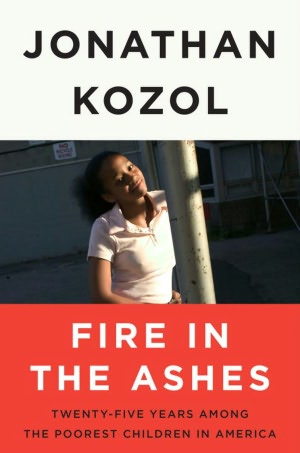
Fire in the ashes : twenty-five years among the poorest children in America / Jonathan Kozol

Call number: HV741 .K674 2012

In this powerful and culminating work about a group of inner-city children he has known for many years, Jonathan Kozol returns to the scene of his prize-winning books Rachel and Her Children and Amazing Grace, and to the children he has vividly portrayed, to share with us their fascinating journeys and unexpected victories as they grow into adulthood. For nearly fifty years Jonathan has pricked the conscience of his readers by laying bare the savage inequalities inflicted upon children for no reason but the accident of being born to poverty within a wealthy nation. A winner of the National Book Award, the Robert F. Kennedy Book Award, and countless other honors, he has persistently crossed the lines of class and race, first as a teacher, then as the author of tender and heart-breaking books about the children he has called “the outcasts of our nation’s ingenuity.” But Jonathan is not a distant and detached reporter. His own life has been radically transformed by the children who have trusted and befriended him.


Never has this intimate acquaintance with his subjects been more apparent, or more stirring, than in Fire in the Ashes, as Jonathan tells the stories of young men and women who have come of age in one of the most destitute communities of the United States. Some of them never do recover from the battering they undergo in their early years, but many more battle back with fierce and, often, jubilant determination to overcome the formidable obstacles they face. As we watch these glorious children grow into the fullness of a healthy and contributive maturity, they ignite a flame of hope, not only for themselves, but for our society. (From Google Books)

The accordion family : boomerang kids, anxious parents, and the private toll of global competition / Katherine S. Newman

Call Number: HQ755.86 .N4888 2012

Why are adults in their twenties and thirties stuck in their parents’ homes in the world’s wealthiest countries?

There’s no question that globalization has drastically changed the cultural landscape across the world. The cost of living is rising, and high unemployment rates have created an untenable economic climate that has severely compromised the path to adulthood for young people in their twenties and thirties. And there’s no end in sight. Families are hunkering down, expanding the reach of their households to envelop economically vulnerable young adults. Acclaimed sociologist Katherine Newman explores the trend toward a rising number of “accordion families” composed of adult children who will be living off their parents’ retirement savings with little means of their own when the older generation is gone.

While the trend crosses the developed world, the cultural and political responses to accordion families differ dramatically. In Japan, there is a sense of horror and fear associated with “parasite singles,” whereas in Italy, the “cult of mammismo,” or mamma’s boys, is common and widely accepted, though the government is rallying against it. Meanwhile, in Spain, frustrated parents and millenials angrily blame politicians and big business for the growing number of youth forced to live at home.

Newman’s investigation, conducted in six countries, transports the reader into the homes of accordion families and uncovers fascinating links between globalization and the failure-to-launch trend. Drawing from over three hundred interviews, Newman concludes that nations with weak welfare states have the highest frequency of accordion families while the trend is virtually unknown in the Nordic countries. The United States is caught in between. But globalization is reshaping the landscape of adulthood everywhere, and the consequences are far-reaching in our private lives. In this gripping and urgent book, Newman urges Americans not to simply dismiss the boomerang generation but, rather, to strategize how we can help the younger generation make its own place in the world.

(From Google Books)

Land grabbers : the new fight over who owns the Earth / Fred Pearce

Call Number: HD111 .P36 2012

An unprecedented land grab is taking place around the world. Fearing future food shortages or eager to profit from them, the world’s wealthiest and most acquisitive countries, corporations, and individuals have been buying and leasing vast tracts of land around the world. The scale is astounding: parcels the size of small countries are being gobbled up across the plains of Africa, the paddy fields of Southeast Asia, the jungles of South America, and the prairies of Eastern Europe. Veteran science writer Fred Pearce spent a year circling the globe to find out who was doing the buying, whose land was being taken over, and what the effect of these massive land deals seems to be.
The Land Grabbers is a first-of-its-kind exposé that reveals the scale and the human costs of the land grab, one of the most profound ethical, environmental, and economic issues facing the globalized world in the twenty-first century. The corporations, speculators, and governments scooping up land cheap in the developing world claim that industrial-scale farming will help local economies. But Pearce’s research reveals a far more troubling reality. While some mega-farms are ethically run, all too often poor farmers and cattle herders are evicted from ancestral lands or cut off from water sources. The good jobs promised by foreign capitalists and home governments alike fail to materialize. Hungry nations are being forced to export their food to the wealthy, and corporate potentates run fiefdoms oblivious to the country beyond their fences.

Pearce’s story is populated with larger-than-life characters, from financier George Soros and industry tycoon Richard Branson, to Gulf state sheikhs, Russian oligarchs, British barons, and Burmese generals. We discover why Goldman Sachs is buying up the Chinese poultry industry, what Lord Rothschild and a legendary 1970s asset-stripper are doing in the backwoods of Brazil, and what plans a Saudi oil billionaire has for Ethiopia. Along the way, Pearce introduces us to the people who actually live on, and live off of, the supposedly “empty” land that is being grabbed, from Cambodian peasants, victimized first by the Khmer Rouge and now by crony capitalism, to African pastoralists confined to ever-smaller tracts.

Over the next few decades, land grabbing may matter more, to more of the planet’s people, than even climate change. It will affect who eats and who does not, who gets richer and who gets poorer, and whether agrarian societies can exist outside corporate control. It is the new battle over who owns the planet.

(From Google Books)

Looking ahead in world food and agriculture : perspectives to 2050 / edited by Piero Conforti

Call Number: HD9000.5 .L655 2011

Are the natural resources available sufficient to feed a growing population? What are the priority areas where investment and research should be directed? How may the use of agricultural products in biofuel production affect markets? How can climate change affect production possibilities and markets? Around these questions, in 2009, FAO organized a High-Level Expert Meeting on How to Feed the World in 2050. This volume follows up on that initiative, by gathering updated versions of technical materials prepared for the occasion, along with further work. The book seeks to sustain the debate on the future of the global agricultural and food economy. Its contents were designed to interest both a technical audience and a wider range of professionals working around the world in areas related to agriculture, in both public and private institutions.

(From Google Books)

E-business and e-commerce management : strategy, implementation, and practice / Dave Chaffey

Call number: HF5548.32 .C472 2007

This book provides the most versatile introduction to e-business and e-commerce available. It is understandable by MBA, Masters and undergraduate students alike. It targets students who struggle with technology and converts them into people who aspire to work in the industry’ Ben Clegg Aston Business School ‘I strongly recommENDE-Business and E-Commerce Management to my students. It covers a wide range of e-business applications, offers a valuable selection of real-world cases and provides a bank of online resources that really help students to get the most from their course.’ Jenny Backhouse University of New South Wales, Australia ‘This is by far the best coverage on the subject and the companion website is unparalleled.’ Marc Macaluso Purdue University Calumet, USA Stay ahead! In today’s fast-paced world of continuous technological development and change you need to know the latest thinking on best practice for e-business.
In the third EDITION of E-Business and E-Commerce Management, leading AUTHORity Dave Chaffey brings the most up-to-date academic thinking and professional practice together in one place. This bestselling text covers all aspects of e-business focusing on sales and marketing, as well as detailing procurement, supply chains, and the legal and security considerations. It has a range of features to help you learn effectively including margin definitions, international case studies, activities and web links. Here are just a few reasons why you should read E-Business and E-commerce Management: Learn from in-DEPTH cases on global organisations such as Amazon, the BBC and eBay, on regional companies such as Tesco.com and dabs.com, and on start-ups such as Northwest Supplies and Zopa.com Get the latest on new e-business technologies and ‘Web 2.0’ applications including blogging, Really Simple Syndication (RSS), instant messaging, podcasting, digital TV and mobile marketing Understand the challenges of security in the face of hacking, viruses, SPAM, identity theft, and the legal constraints on data protection, privacy and accessibility Keep up with cutting-edge e-marketing and E-CRM techniques, such as affiliate, search engine and viral marketing, and the use of ‘customer personas’ and value analysis Learn a structured approach to plan and implement, assess and improve e-business strategy for different types of organisation. Developed for students studying e-business and e-commerce at undergraduate or postgraduate level, and also used by many business managers, E-Business and E-Commerce Management is the essential text to keep pace with technology, strategy and implementation. Dave Chaffey (www.davechaffey.com) is an e-business consultant and visiting lecturer on e-business courses at Warwick University and Cranfield School of Management. (From Google Books)

Career guide to America’s top industries : essential data on job opportunities in over 40 industries

Call number: HF5382.5.U5 C315 2004

This book is a reprint of the government’s Career Guide to Industries at a lower price. It is issued shortly after the Occupational Outlook Handbook (OOH) every two years and contains helpful information for job seekers on industry trends and cross-references to OOH job titles. The book covers more than 40 industries and includes the following information on each one: significant points, nature of the industry, working conditions, employment, occupations in the industry, training and advancement, earnings, outlook, and sources of additional information. Ideal for students and other people doing career research, people seeking jobs in new or unfamiliar industries, people interested in certain industries rather than particular jobs, and people with interests and job skills that are needed in many types of businesses. (From Google Books)

Shop ‘Till You Drop DVD

Tracking number: 130GE

Are we too materialistic? Are we willfully trashing the planet in our pursuit of things? And what’s the source of all this frenetic consumer energy and desire anyway? In a fast-paced tour of the ecological and psychological terrain of American consumer culture, Shop ‘Til You Drop challenges us to confront these questions head-on. Taking aim at the high-stress, high-octane pace of fast-lane materialism, the film moves beneath the seductive surfaces of the commercial world to show how the flip side of accumulation is depletion — the slow, steady erosion of both natural resources and basic human values. In the end, Shop ‘Til You Drop helps us make sense of the economic turbulence of the moment, providing an unflinching, riveting look at the relationship between the limits of consumerism and our never-ending pursuit of happiness.

Deadly spin : an insurance company insider speaks out on how corporate PR is killing health care and deceiving Americans / Wendell Potter

Call number: HG9383 .P68 2010

Wendell Potter is the insurance industry’s worst nightmare. In June 2009, Wendell Potter made national headlines with his scorching testimony before the Senate panel on health care reform. This former senior VP of CIGNA explained how health insurers make promises they have no intention of keeping, how they flout regulations designed to protect consumers, and how they skew political debate with multibillion-dollar PR campaigns designed to spread disinformation. Potter had walked away from a six-figure salary and two decades as an insurance executive because he could no longer abide the routine practices of an industry where the needs of sick and suffering Americans take a backseat to the bottom line.
The last straw: when he visited a rural health clinic and saw hundreds of people standing in line in the rain to receive treatment in stalls built for livestock. In Deadly Spin, Potter takes readers behind the scenes to show how a huge chunk of our absurd healthcare spending actually bankrolls a propaganda campaign and lobbying effort focused on protecting one thing: profits. Whatever the fate of the current health care legislation, it makes no attempt to change that fundamental problem.
Potter shows how relentless PR assaults play an insidious role in our political process anywhere that corporate profits are at stake—from climate change to defense policy. Deadly Spin tells us why—and how—we must fight back. (From Google Books)