 By Library Clerk David Winn
In the past month, there have been two events which, although completely unrelated, seem to occupy the same realm of public consciousness. On February 27th, we lost Leonard Nimoy at age 83, the actor most famously known as Mr. Spock, the eminently logical lieutenant commander of the USS Enterprise in the sci-fi series Star Trek. Nimoy’s
 |
| Leonard Nimoy in Star Trek |
performance became a crucial part of defining the iconic crew who instilled a set of values in a generation of fans as William Shatner spoke the credo ”to explore strange new worlds, to seek out new life and new civilizations, to boldly go where no man has gone before.” These words seem wholly appropriate as NASA’s probe Dawn approaches the dwarf planet Ceres, a large body in the asteroid belt between Mars and Jupiter that has been photographed from afar but never properly explored or analyzed beyond what space telescopes and mathematics allow.Even as fans mourn Nimoy’s passing and celebrate his life, missions like this prove that mankind is more eager than ever to exercise their own inclinations to explore new worlds, in ways that may have been seen as relegated to the realm of science fiction only decades ago.
Decades is sometimes a necessary term when talking about space exploration. Due to the amount of planning, the exorbitant amount of funding, and the logistics of allowing craft to travel millions of miles, the time between conceptualization of a mission and realization of its objective can be a long stretch. This particular mission that would eventually allow Dawn to reach Ceres saw its start in 1996, did not achieve funding until 2004, and is just now reaching Ceres in 2015, although its initial objective the asteroid Vesta was reached in mid-2011. Now that Dawn has reached Ceres, it will still take roughly a month for it to achieve a place in the dwarf planet’s orbit suitable for transmitting back data to the scientists stationed on Earth. Space science is not a realm of instant gratification. Those on the outside may need to temper their expectations as to what this type of mission may discover, even though to NASA scientists it has the possibility to be immensely exciting.
 The hope is not to find the gleaming spires of crystalline palaces amidst the dwarf planet’s crags, or the broken apart remnants of an alien civilization’s spaceships jutting from the ice cap. What is of immense interest is the possibility of liquid water, one of the crucial elements to life on our planet and a hint that abiogenesis could occur elsewhere in our solar system, even if it was relegated to the simplest of life forms.In the case of Dawn’s mission, one of the primary objectives is not to search for remnants of possible unicellular organisms such as with the Curiosity rover on Mars, but rather to help determine more information about how bodies like Ceres and Vesta form. Carol Raymond, Dawn’s deputy principal investigator recently told CBS news, “We know that Ceres retained a lot of volatiles and its shape is consistent with a differentiation into a rocky core and an ice mantle,” and then added, “It’s inevitable that that ice would have existed as an ocean at some time in the past.”She also refers to Ceres and Vesta as “fossils,” and this is accurate in the way that NASA’s scientists will be trying to forensically understand what happened in the past on a geological time scale that dwarfs that of paleontologists studying the fossils of biological organisms.
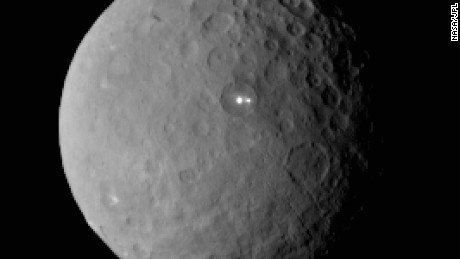
If that’s not immediately gripping, there is a bit of genuine mystery to pique your curiosity. Photos of Ceres from far away show two bright spots that appear almost reflective in nature and can be downright eerie given Ceres’ total isolation in the blackness of space. This yet unidentified geographical feature could be an example of cryovolcanism, a process that results in ice volcanoes that spew compounds of water and methane instead of molten rock. A slightly more mundane explanation is simply that a small portion of the icy core has broken through to the surface, hence the bright, reflective spot on an otherwise rocky façade. Whatever the reason, these are types of questions that can’t be answered with telescopes from Earth or mathematics calculations of what could hypothetically be expected to happen on a body such as Ceres. With our limited ability to transport human beings to other worlds, missions like this are currently our best option for getting a first-hand look at alien worlds and evidence of how they actually came to be.
 Before I leave you today, I’d like to return to the image of those two bright spots on Ceres, two bright eyes staring back like the glowing tapetum lucidum of a lion caught by the flash of a camera. This is more than just a new, memorable image from space. This is the man on the moon, the face we’ve seen for centuries before we brought a man up to meet him. This is the face on Mars, or the countless other strange shapes that humans have tried to ascribe meaning to as we sift through new photographs from these distant worlds. This phenomena is a type of pareidolia, the human inclination to find order and recognizable patterns where there is none, especially in the case of anthropomorphizing things. This can be attributed to an evolutionary need for self-preservation; if your mind is accustomed to finding the face of a predator amongst the jungle foliage, then you might have a leg up when there actually is a predator skulking there. In some ways, I don’t think much has changed. As we gaze upon these alien worlds, we look for the little pieces of relatable humanity. It helps keep us grounded as we ponder the enormity of the unexplored universe that awaits us.Then again, maybe these worlds are not so foreign after all. Perhaps it is our inexorable connection with all of the cosmos that spurs us forward to each new discovery.
As we look forward to what can be learned from observing Ceres, ponder for just a moment the words of Carl Sagan from Cosmos: A Personal Voyage: “Some part of our being knows this is where we came from. We long to return. And we can. Because the cosmos is also within us. We’re made of star-stuff. We are a way for the cosmos to know itself.”









 Fort Wayne & Warsaw Library Blogs
