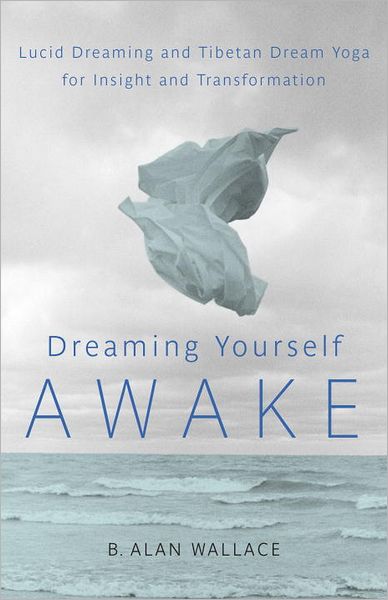
Dreaming yourself awake : lucid dreaming and Tibetan dream yoga for insight and transformation / B. Alan Wallace ; edited by Brian Hodel

Call Number: BF1099.L82 W35 2012

Some of the greatest of life’s adventures can happen while you’re sound asleep. That’s the promise of lucid dreaming, which is the ability to alter your own dream reality any way you like simply by being aware of the fact that you’re dreaming while you’re in the midst of a dream. There is a range of techniques anyone can learn to become a lucid dreamer—and this book provides all the instruction you need to get started. But B. Alan Wallace also shows how to take the experience of lucid dreaming beyond entertainment to use it to heighten creativity, to solve problems, and to increase self-knowledge. He then goes a step further: moving on to the methods of Tibetan Buddhist dream yoga for using your lucid dreams to attain the profoundest kind of insight.

(From Google Books)

Read with me : best books for preschoolers / Stephanie Zvirin

Call Number: Z1037 .Z88 2012

There is a whirl of new books and learning products on the market every day. But what are the most enjoyable, the classic favorites, or the new, hot books that your young child will enjoy and cherish? The best source for solid picks is from those in the know: librarians who work with children and parents. This guide was developed with parents, grandparents, teachers, and day care providers in mind, to help them make wise and thoughtful purchases of books and learning materials that are enjoyable, educational, and age-appropriate.

 You will learn:

  • Where to start
  • Picture books for early learners
  • The classics
  • Reading along
  • A trip to the library can help

(From Google Books)

Teaching in the digital age : smart tools for age 3 to grade 3 / Brian Puerling ; [foreword by] Carol Copple

Call Number: LB1139.35 .C64 P84 2012

Technology is rapidly changing the ways we live our lives and interact with the world. It’s also changing how you teach. Technology can enhance your classroom’s complete curriculum and assessment and help you create and capture meaningful experiences, support inquiry, and expand your classroom’s walls. This comprehensive framework will help you select and use a variety of technology and interactive media tools in your classroom, including digital cameras, audio recorders, webcams, publication and presentation tools, and multi-touch mobile devices.

Reflecting Technology in Early Childhood Programs, the joint position statement of the National Association for the Education of Young Children and the Fred Rogers Center, Teaching in the Digital Age includes:

  • Developmentally appropriate and effective strategies to use technology to facilitate children’s learning
  • 28 links to video clips that provide a deeper look at how these practices are used in real classrooms
  • 32 forms to help you plan, reflect on, and evaluate how you use technology to help children learn

Brian Puerling, a National Board Certified Teacher, is a graduate of the Erikson Institute and the director of technology education at Catherine Cook School in Chicago. He is a former preschool teacher with Chicago Public Schools and has also worked as an early childhood teacher coach, a curriculum reviewer, and a professional development facilitator for Chicago Public Schools, Rush University Medical Center Science and Math Excellence Network, and Rochelle Lee’s Boundless Readers. Brian participated in the Erikson Early Mathematics Project, is active in the Chicago Metro AEYC, and is a member of the NAEYC Tech and Young Children Interest Forum, which works to provide early childhood educators with high quality implementation and research resources. Brian recently joined the Sesame Workshop Teacher Council, where he shares his knowledge on trends in early childhood education and technology movements to help guide the planning for future programming of their television shows. Brian was a recipient of the PBS Innovative Educator Award and PBS Teacher’s Choice Award in 2010.

(From Google Books)

Looking ahead in world food and agriculture : perspectives to 2050 / edited by Piero Conforti

Call Number: HD9000.5 .L655 2011

Are the natural resources available sufficient to feed a growing population? What are the priority areas where investment and research should be directed? How may the use of agricultural products in biofuel production affect markets? How can climate change affect production possibilities and markets? Around these questions, in 2009, FAO organized a High-Level Expert Meeting on How to Feed the World in 2050. This volume follows up on that initiative, by gathering updated versions of technical materials prepared for the occasion, along with further work. The book seeks to sustain the debate on the future of the global agricultural and food economy. Its contents were designed to interest both a technical audience and a wider range of professionals working around the world in areas related to agriculture, in both public and private institutions.

(From Google Books)

Land grabbers : the new fight over who owns the Earth / Fred Pearce

Call Number: HD111 .P36 2012

An unprecedented land grab is taking place around the world. Fearing future food shortages or eager to profit from them, the world’s wealthiest and most acquisitive countries, corporations, and individuals have been buying and leasing vast tracts of land around the world. The scale is astounding: parcels the size of small countries are being gobbled up across the plains of Africa, the paddy fields of Southeast Asia, the jungles of South America, and the prairies of Eastern Europe. Veteran science writer Fred Pearce spent a year circling the globe to find out who was doing the buying, whose land was being taken over, and what the effect of these massive land deals seems to be.
The Land Grabbers is a first-of-its-kind exposé that reveals the scale and the human costs of the land grab, one of the most profound ethical, environmental, and economic issues facing the globalized world in the twenty-first century. The corporations, speculators, and governments scooping up land cheap in the developing world claim that industrial-scale farming will help local economies. But Pearce’s research reveals a far more troubling reality. While some mega-farms are ethically run, all too often poor farmers and cattle herders are evicted from ancestral lands or cut off from water sources. The good jobs promised by foreign capitalists and home governments alike fail to materialize. Hungry nations are being forced to export their food to the wealthy, and corporate potentates run fiefdoms oblivious to the country beyond their fences.

Pearce’s story is populated with larger-than-life characters, from financier George Soros and industry tycoon Richard Branson, to Gulf state sheikhs, Russian oligarchs, British barons, and Burmese generals. We discover why Goldman Sachs is buying up the Chinese poultry industry, what Lord Rothschild and a legendary 1970s asset-stripper are doing in the backwoods of Brazil, and what plans a Saudi oil billionaire has for Ethiopia. Along the way, Pearce introduces us to the people who actually live on, and live off of, the supposedly “empty” land that is being grabbed, from Cambodian peasants, victimized first by the Khmer Rouge and now by crony capitalism, to African pastoralists confined to ever-smaller tracts.

Over the next few decades, land grabbing may matter more, to more of the planet’s people, than even climate change. It will affect who eats and who does not, who gets richer and who gets poorer, and whether agrarian societies can exist outside corporate control. It is the new battle over who owns the planet.

(From Google Books)

Encyclopedia of new venture management / editor, Matthew R. Marvel

Call Number: HD62.5 .E534 2012 Reference (Does Not Circulate)

New venture management requires all the skills obtained within the typical MBA program, and then some. While those entering traditional management positions within established companies might expect to find established customers, a degree of predictability, formalized procedures, and earnings that may be taken more-or-less for granted, new ventures often are launched into highly dynamic environments characterized by rapid technological change, inherent unpredictability, and an uncertain cash flow. Such ventures often require rapid growth to succeed. While new ventures offer those who initiate them a high degree of independence, excitement, and potential for great reward, they also bring high risk, stress, and greater potential for failure. Thus, it takes a special set of skills, techniques, and temperament to succeed. These skills, along with the potential risks and rewards and environmental settings and characteristics, are explored in the Encyclopedia of New Venture Management.

Features & Benefits:

  • 150 carefully selected signed entries (each with Cross References and Further Readings) are organized in A-to-Z fashion to give students easy access to the full range of topics in new venture management.
  • A thematic Reader’s Guide in the front matter groups related entries by broad topical and thematic areas to make it easy for users to find related entries at a glance, with themes that include “Entrepreneurial Decision Making,” “Corporate Entrepreneurship,” “Entrepreneurial Marketing,” “Leadership & Human Resources,” “Financing & Development,” and more.
  • In the electronic version, the Reader’s Guide combines with a detailed Index and the Cross References to provide users with robust search-and-browse capacities.
  • A Chronology in the back matter helps students put individual events into broader historical context.
  • A Glossary provides students with concise definitions to key terms in the field.
  • A Resource Guide to classic books, journals, and web sites (along with the Further Readings accompanying each entry) helps guide students to further resources for their research journeys.
  • An appendix includes the report, “The State of Small Business.”

(From Google Books)

American grown : the story of the White House kitchen garden and gardens across America / Michelle Obama

Call Number: SB466 .U7 W4835 2012

Through telling the story of the White House Kitchen Garden, First Lady Michelle Obama explores how increased access to healthful, affordable food can promote better eating habits and improve health for families and communities across America. Mrs. Obama will describe how Sasha and Malia were the catalysts for change for their family’s eating behavior which inspired her national initiative to address childhood obesity and resulted in the idea to plant a vegetable garden on the South Lawn, the first since Eleanor Roosevelt’s Victory Garden. American Grown will be inspirational and instructive and will provide ideas for readers to get involved and join the movement to create community gardens, support local farmers markets, create school gardens, and start urban gardens, as well as other ways that they can make small changes to achieve big results and create healthy eating habits. Since entering the White House, Mrs. Obama has emerged as a passionate advocate for healthful eating and exercise. In February 2010 she launched Let’s Move!, a nationwide initiative to address the epidemic of childhood obesity by empowering parents and caregivers with information, improving food quality in schools, increasing access to healthy, affordable food, and encouraging increased physical activity. American Grown will speak to these issues which Mrs. Obama has strongly advocated for, in particular, making better food choices. It will also include practical ideas, recipes, and resources as well as tips on how to begin a garden of any size, anywhere and how to support local farmers’ markets. Filled with gorgeous full-color photography, American Grown will include stunning photos of the White House garden and Mrs. Obama throughout the seasons, as well as other community and school gardens from around the country.

(From Google Books)

New everyday science explained : from the big bang to the human genome … and everything in between / by Curt Suplee.

Call Number: Q162 .S943 2003

On a quiet afternoon, you settle in for some long-awaited reading. All is restful, still, serene. And yet, almost imperceptibly, your surroundings seethe with activity. Light beams produced 93 million miles away stream through your window and slam onto the page at 186,000 miles per second. The air in your home writhes with constant changes in temperature. A bird sings, and atoms in the air collide with your eardrums at hundreds of miles per hour. All the while, Earth’s rotation is whipping you around the sun at 18 miles per second. Frenetic though they seem, these activities happen according to natural laws that make our world predictable. And now, in this newly-updated bestseller from National Geographic, the hows and whys of science become engagingly clear.

(From Google Books)

Plastic-free : how I kicked the plastic habit and you can too / Beth Terry

Call Number: TD196 .P85 T47 2012

Like many people, Beth Terry didn’t think an individual could have much impact on the environment. But while laid up after surgery, she read an article about the staggering amount of plastic polluting the oceans and decided then and there to kick her plastic habit. Now she wants to teach you how you can too. In her quirky and humorous style—well known to the readers of her popular blog, My Plastic-Free Life—Terry provides personal anecdotes, stats about the environmental and health problems related to plastic, and personal solutions and tips on how to limit your plastic footprint.

Terry includes handy lists and charts for easy reference, ways to get involved in larger community actions, and profiles of individuals—Plastic-Free Heroes—who have gone beyond personal solutions to create a change on a larger scale. Plastic-Free also includes chapters on letting go of eco-guilt, strategies for coping with overwhelming problems, and ways to relate to other people who aren’t as far along on the plastic-free path. Both a practical guide and the story of a personal journey from helplessness to empowerment, Plastic-Freeis a must-read for anyone concerned about the ongoing health and happiness of themselves, their children, and the planet.

(From Google Books)

RSMeans electrical cost data 2012, 35th annual ed.

Call Number: TK435 .M42 2012 Reference (Does Not Circulate)

This is an invaluable resource for anyone involved with the installation, planning and maintenance of electrical equipment and systems. The RSMeans 2012 Electrical Cost data book will reflect the volatility of material and labor costs in the coming year. It contains the latest electrical components and materials, Up-to-date unit prices, Electrical systems prices as well as Extensive estimating reference tables.

(From Google Books)