A Brief Guide to Help Finish Your Paper

Imagine, if you will, you have a paper due tomorrow. The paper will not only decide whether you pass the class; the class is contingent upon your graduation. To make matters worse, despite your desperate situation, the paper’s subject only encourages you to procrastinate, and you have convinced yourself that the increasing pressure to finish will help you focus in the two hours before the paper needs to be submitted. Maybe your situation is not this dire, but it may feel that way. Here are some tips to make starting or finishing a little less panic inducing.

  1. As long as it is within the boundaries of your assignment, write the paper that would capture your attention. Keep it academic, but take liberties; tell a story with your thesis; get creative. Think about why you are not connecting to the subject and use your perspective as a way to critically analyze the topic.
  2. Collect your sources ahead of time. Even if you have yet to write anything else, add all the references you intend to include in your paper. Think about how each reference supports your thesis and organize them accordingly throughout what will be your introduction, body, and conclusion. All you would need to do is then combine and support each with your own ideas.
  3. Remember how relieved you were when you last finished a paper? The final product might have even impressed you. It was not a fluke. The same prospects apply this time. Don’t let pressure cloud your impression. You wrote that paper, and you will do it again.

If preparation is less of a problem for you, but you would like to improve your writing, the following titles might interest you. Thanks to the library’s collection of eBooks, you do not even need to leave the comfort of your home to benefit from our selection.

10 Steps to Successful Business Writing, 2nd Edition
The Student Guide to Writing
Seven Steps to Confident Writing
Writing Fantastic Fiction

Find those and other books on any academic subject you need through Ivy Tech Library’s catalog database, IvyCat!

NATIVE AMERICAN HERITAGE MONTH

This November, please join us in celebrating Native American heritage!

Help us tell all Americans’ stories. Of the many Native Americans spotlighted at Ivy Tech Library, the three below are often regarded as exceptional. Stop by this month to collect one of their bookmarks!

Ben Nighthorse Campbell
U.S. Senator

Born in 1933 of a Portuguese immigrant mother and Northern Cheyenne father, Campbell is one of 44 chiefs of the Northern Cheyenne Tribe. He earned a degree in physical education and fine arts after serving in the U.S. Air force from 1951-1953. He served in the Colorado State Legislature before being elected to the U.S. House of Representatives in 1987. He won his bid to become a senator in 1992 and won re-election in 1998.

Henry, C. Ben Nighthorse Campbell: Cheyenne Chief and U.S. Senator. Broomall, PA: Chelsea House, 1994.

Maria Tallchief
Prima Ballerina

From 1947 to 1960, Maria Tallchief performed with the New York City Ballet, gaining prima ballerina status. Later she danced with the American Ballet Theatre, returning to the New York City Ballet in 1963 until her retirement in 1965. But she didn’t retire from dance. She directed the Lyric Opera Ballet of Chicago and founded the Chicago City Ballet in 1981. She was the latter’s artistic director through 1987.

Tallchief, Maria and Kaplan, L. Maria Tallchief: America’s Prima Ballerina. New York: Henry Holt, 1997.

Winona LaDuke
Activist, Author

A member of the Anishinaabeg (Ojibew) tribe, Winona LaDuke’s activism dates back to her teens. At age 18 she spoke before the United Nations about Indian issues. While at Harvard earning an economics degree, she worked with grassroots Native American organizations in various states. After graduation, she moved to the White Earth reservation in northern Minnesota, where she lives today with her family.

LaDuke, Winona. All Our Relations: Native Struggles for Land and Life. Cambridge, Mass.: South End Press, 1999. Ms. Magazine, April/May 2001, pp. 46-53.

Find the following eBooks on Ivy Tech Library’s catalog website, IvyCat!

I am where I come from: Native American college students and graduates tell their life stories

Plundered Skulls and Stolen Spirits: Inside the Fight to Reclaim Native America’s Culture

Indigenous Pop: Native American Music from Jazz to Hip Hop

Follow the official celebration here:

National Book Festival 2019 Videos released

The Library of Congress is currently rolling out videos from author talks at the 2019 National Book Festival. This annual event is sponsored by the Library of Congress and takes place in Washington, D.C. at the end of August. (It is much more comfortable to view these talks online – August in D.C. is truly swampy!)

This year, there are many wonderful videos from the Science stage reporting current research, as well as popular writers on history, politics, biography, and of course fiction and poetry and children’s books. We have books by most of these authors in our collection.

Click on this link to access the list of videos. The easiest way to browse the list is to click on Sort by Title to see author names interfiled with titles.

Image showing how to sort the list by title

NATIONAL NOVEL WRITING MONTH, Part 2

Whether or not you have committed to the herculean task of scribing 1,667 words daily for a month, you have surely shared the existential dread that comes with an incomplete paper or essay staring back at you.

During NaNoWriMo‘s campaign, accomplished authors are invited to contribute insights or pep talks for fellow writers. The following are some tips that most resonated with me. If you are stuck or could just use a break, these reflections might be helpful to you too.

Jason Reynolds
When you make it to the 3/4 mark of your novel, if you are anything like me, you’re saying one of two things to yourself:

1. I’ve come far enough… to stop. I mean, seriously, I basically wrote a whole novel. I could at least tell people I wrote a whole novel. It’d be a lie. But I wouldn’t feel bad about it. At least not too bad. Because it’s basically whole.

Or 2. I can see the end. I can actually see it. So now I’m going to teleport there. . . .

Anyway, the point is you are ready and willing to cram the next five chapters into the next five sentences.

Don’t do either of these things.

Marie Lu
Just Keep Going.

Write an entire monologue with your main character if you have to. Spend a chapter just exploring the life story of an antagonist. Write a scene with nothing but dialogue between your hero and your villain. Write a steamy love scene between your favorite couple. They don’t have to be scenes in chronological order. They don’t even have to end up in your book. But they will help you to keep going.

Andy Weir
Sometimes, when you’re writing, things come together easily and you can crank out 2,000 words in an afternoon. But other times, it’s torture just to crap out 300 words. In those rough patches, here’s something to keep yourself going: When you read the pages later, you won’t be able to tell which ones you wrote with good flow and which ones were hard. You’re creating the same quality of work in both cases. You might not believe me, but the next time it happens to you, check the results later. You’ll see for yourself. So when you’re having a rough patch, it helps to remember that you’re making progress toward a goal. The words you’re putting down aren’t wasted. They’re just as good as the rest.

National First-Generation College Celebration, Nov. 8th

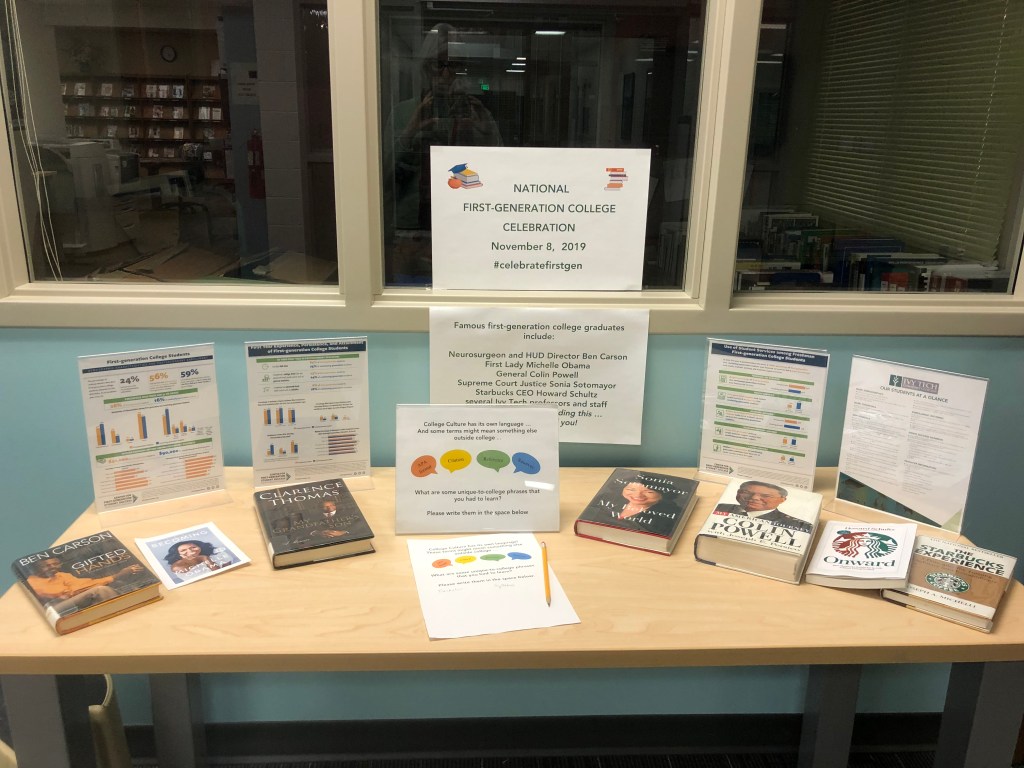
Library display about first generation college students

All this week we are celebrating first-generation college graduates. This includes many of our Ivy Tech staff, and graduates.

We have a display of selected books by famous first-gens, including neurosurgeon Ben Carson, First Lady Michelle Obama, Supreme Court Justices Sonia Sotomayor and Clarence Thomas, General Colin Powell, and Starbucks CEO Howard Schultz. The books are already getting checked out, so come take a look soon!

The most recent data available (from 2016) shows that 24% of all college students are first-generation. At community colleges, the percentage is 64%. Data also shows that while most first-generation students get financial aid, they do not partake of other college services like academic support and counseling at the same rates as other students (US Dept. of Education). As these helps are often crucial to success in college, this gap is concerning.

College is a new culture, no matter how academically prepared one is. We are having some fun with this by asking people to write down words or phrases that they had to learn – or learn a new meaning of – when they started college. My favorite is “citation”! (I’m sorry, Officer …)

What are some college words you had to learn? Leave a comment here, or come in to the library and help us out with this.