All posts by Ann

Librarian, Liaison for School of Public Affairs & Social Services; School of Advanced Manufacturing , Engineering & Applied Technology; School of Business & Logistics

Scribd is providing free access to popular Ebooks and periodicals

Scribd is a subscription ebook and audiobook service. For one month staring March 17th to April 17th, they are providing free access to their collections for any new customer. Access will end; you will not be automatically enrolled. We have tried this free service and recommend it. We were required to download a free app on our mobile phone to use the service.

Reading a ripping yarn is a great way to relax during these stressful times. You will find many of the same titles in the Scribd ebook collection as we have in our current Baker & Taylor print collection. The Scribd collection also includes the New York Times, Wall Street Journal, Financial Times, The Atlantic, and other titles useful for course work assignments. (We have access to these titles in our databases, with various embargo periods.)

Here is the link to sign up: https://www.scribd.com/readfree?utm_source=readfree


Pi à la Mode

IMG_4546

Every year on March Fourteenth people around the world celebrate the most famous mathematical constant: the ratio of the length of the circumference of a circle to its diameter. This is an irrational number, approximated to 3.14 (or 3.1415926) and represented by the Greek letter π. As a number, π is transcendental and real as well as irrational. Mathematician James Glaisher remarked of π that “a complete account of its calculation would almost amount to a history of mathematics.” (Quoted in: William Dunham, The Genius of Euler: Reflections on His Life and Work: On the History of Euler’s Constant (The Mathematical Association of America, 2007), p. 147.)

π has been calculated out to over a trillion decimal places, but we still do not know where it ends! Competitions to recite the known sequence of digits are held regularly around the world. (See pi-world-ranking-list.com for record-setting recitations.)

Mathematician Mark Kac noted that “pi, so intimately connected with circles, keeps cropping up in probability theory and statistics, the two disciplines which deal with randomness and luck.” (Mark Kac, Enigmas of Chance: An Autobiography: The Search for the Meaning of Independence (Harper & Row, 1985), p. 55.) We have an activity set up for you to experience this, based on Buffon’s Needle, the proof named after Georges-Louis LeClerc, Comte de Buffon, a scientist who enjoyed gambling.

The Greek letter π is pronounced like our English word “pie” – hence the puns, since pie is usually made in a circular pan, and, being a delicious pastry, may be difficult to divide fairly, as memorialized in the old English nursery rhyme:

A was once an Apple pie; B bit it; C cut it; D dealt it; E eat it; F fought for it; G got it; H had it; I inspected it; J joined it; K kept it; L longed for it; M mourned for it; N nodded at it; O opened it; P peeped in it; Q quartered it; R ran for it; S stole it; T took it; U upset it; V viewed it; W wanted it; X, Y, Z, and ampersand, all wished for a piece in hand.

March Fourteenth is also the birthday of Albert Einstein (b. 1879), who theorized what is perhaps the most famous equation using a constant in our universe: the relationship of mass to energy, represented by E=mc2 (E=energy; m=mass; c=the speed of light).

March Fourteenth is the death anniversary of another famous physicist: Stephen Hawking (d. 2018) who developed theories about the origins of our universe, and black holes, based on Einstein’s work.

The Library is displaying books by and about Einstein and Hawking, plus books on number theory and pastries, this month.

Come on in for some Pi!


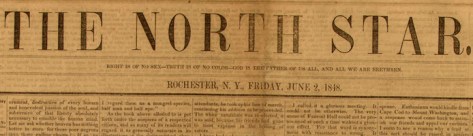
Frederick Douglass Newspapers and other Abolitionist sources

NorthStarMasthead

Frederick Douglass was a great orator, eloquent writer, and the publisher of three newspapers supporting the cause of Abolition. After escaping enslavement, his own freedom was bought with funds raised from his speaking tour of Europe. Douglass championed African-American owned newspapers as essential, declaring that:  “the man who has suffered the wrong is the man to demand redress,—that the man STRUCK is the man to CRY OUT—and that he who has endured the cruel pangs of Slavery is the man to advocate Liberty.”

The Library of Congress has now digitized their entire Frederick Douglass Newspaper Collection and made it freely available and searchable online. This is a subset of the Frederick Douglass Papers collection which they also curate. Although the Library holds the largest collection of his newspapers, it does not include every issue, because the Douglasses’ house was burned (by suspected arson) destroying part of his library where archival copies were stored.

Douglass was involved in publishing newspapers from the 1840s into the 1870s. These are powerful primary sources for learning about the experiences of African Americans in the United States from the antebellum era through Reconstruction. The Library of Congress provides freely downloadable teaching kits for the Frederick Douglass Papers, and for other primary sources from this time.

Other digital collections of Frederick Douglass papers are at Indiana University – Purdue University Indianapolis; and in the New York Heritage Digital Collections.

In the Frederick Douglass collections one can find connections to Fort Wayne and the African-American and Abolitionist communities here. Henry Ward Beecher was a correspondent of Douglass; his father Lyman Beecher headed Lane Theological Seminary in Cincinnati during the period it was splintered by abolitionism. Henry Beecher visited Fort Wayne in 1843 and convinced members of the First Presbyterian Church – until then served by the abolitionist pastor Alexander T. Rankin – to split off and form another abolitionist congregation, which his brother Charles served as pastor for its first six years. Indiana was not a slaveholding state, but the position of African Americans was precarious within its borders. Rankin’s house in downtown Fort Wayne has been identified as a stop on the underground railroad.

Among our books dealing with abolitionist activism in Fort Wayne are:

The Underground Railroad and the Antislavery Movement in Fort Wayne and Allen County, Indiana by Angela M. Quinn – View Record in IvyCat

Slavery and the Meetinghouse: The Quakers and the Abolitionist Dilemma, 1820-1865 by Ryan P. Jordan – View Record in IvyCat

Indiana, 1816-1850: The Pioneer Era by Donald F. Carmony – View Record in IvyCat

Homeless, Friendless, and Penniless: The WPA Interviews with Former Slaves Living in Indiana compiled by Ronald L. Baker – View Record in IvyCat

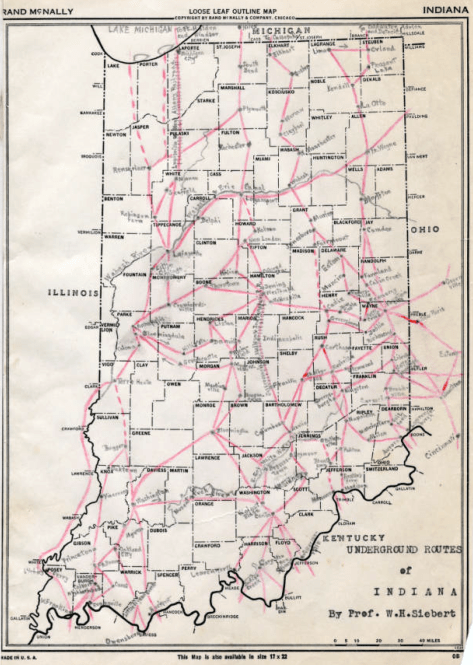
A trove of primary sources relating to the Underground Railroad in Indiana, Illinois, and Ohio is The Wilbur H. Siebert collection, available online from the Ohio Memory Network. Professor Siebert, of Ohio State University, began the project with his history students in the 1890s. They were able to interview former fugitives, “railroad agents,” and others for whom escapes were living memory. The Siebert collection includes this map of escape routes through Indiana on which Fort Wayne is a node.

SiebertUGRRmap2-1

Image courtesy of the Ohio History Connection

New book on the Hong Kong protests

41VhDCFwSDL._SX331_BO1,204,203,200_

Hong Kong in the Shadow of China: Living with the Leviathan

By Richard C. Bush

Call Number: JQ1539.5.A91 B87 2016

View in IvyCat

“Hong Kong in the Shadow of China tells the story of why the “Umbrella Movement” failed to bring Hong Kong a more democratic system … the Umbrella Movement, so called because of the umbrellas protesters carried for protection against ran and pepper spray, … only punctuated a protracted debate over how to vest leaders with more legitimacy, while preserving social stability … [protests] became the background before which members of the Chinese and Hong Kong governments, the business community, politicians of every stripe, and political activists held fraught discussions on electing Hong Kong’s chief executive through universal suffrage and on whether China should control the process. Because there was too little trust among these political forces, a significant opportunity for progress was missed … Richard Bush takes us inside the debates and demonstrations and then pulls back to critically explore what Hong Kong and China must do to ensure both economic competitiveness and good governance and how these developments affect United States policy” (publisher).

Richard Bush has gathered recent survey data and other primary sources that will remain relevant to the ongoing debates about Hong Kong. The book includes extensive notes and an index. Bush is a senior fellow in the Foreign Policy program at the Brookings Institution and director of its Center on East Asia Policy Studies. He worked for nineteen years in the U.S. government on Asia policy issues, including Hong Kong.

Off the Charts!

We have acquired two new publications on statistics. Both are of general interest and applicable across our curriculum.

SpiegelhalterStatistics

The Art of Statistics: How to Learn from Data

By David Spiegelhalter

Call Number: QA 276.12 .S665 2019

View in IvyCat

As the title makes clear, this book is an invitation to better data literacy. Sir David manages to make complex ideas simple and fun, by choosing real-world applications of statistics with a sense of humor. He covers the whole process of posing problems, collecting data, and doing analysis. Aimed at students, this is also a “best of” teaching examples collection. (Readers can find more Spiegelhalter on the BBC podcast More or Less.)

Anyone who teaches about data, or does experiments, will find this book illuminating. So will anyone trying to make sense of all the political polling in the news. If you are struggling with a statistical concept, try reading what he has to say about it.

The many illustrations and charts are clear, though in grayscale; and the hardcover format will preserve the library’s copy despite the U.S. publisher’s decision to print the book on cheap paper.

Atlas2016Elections

Atlas of the 2016 Elections

Edited by Robert. H. Watrel, Ryan Weichelt, Fiona M. Davidson, John Heppen, Erin H. Fouberg, J. Clark Archer, Richard L. Morrill, Fred M. Shelley, and Kenneth C. Martis.

Call Number: G 1201 .F9 A8 2018

View in IvyCat

The 2016 US presidential election was historic for many reasons – the first woman heading a major party ticket, fractious party conventions, allegations of foreign interference, the less-probable result. This book is the latest in an acclaimed series examining presidential elections, and draws on that past data. It is a useful reference work for history, political science, sociology, and argumentative essays.

Scholars from across disciplines including data science, geography, political science, and sociology have contributed analyses. Many are established regional demographic specialists.

In brief narratives and at-a-glance maps, they present insightful perspectives on the 2016 election, from the usual demographic polling and voting patterns, to campaign contributions, “religiosity,” and concurrent Twitter trends. They consider political currents both at the hyperlocal level (such as minimum wage and marijuana referenda) and international level (such as anxiety about wages, free trade, and immigration) that everywhere cut across party lines.



Scholarship is a Conversation – What will You say?

citations-display-board.jpg

The concept of scholarship as a conversation reflects the origins of learned societies and their journals. Many journals still in existence – such as Philosophical Transactions of the Royal Society – began as correspondence between researchers working on similar topics. For example, the circles of Samuel Hartlib and Henry Oldenburg sent such letters to each other; both are associated with the Royal Society of London for Improving Natural Knowledge (its full name), the oldest scientific society in the world. (Encyclopedia Britannica has excellent articles with sources on both these gentlemen and the Society.)

The Association of College & Research Libraries includes “Scholarship As Conversation” in its Framework for Information Literacy in Higher Education. The framework, meant to be open to instantiation in different contexts, emphasizes citations as representing this conversation.

Citations help researchers to find more research, as when you find an article that was cited in another article or book or website. That sense of being “on the trail” of an idea is one of the joys of research. Even more exciting is when you formulate your own point of view on a topic, built on information others have provided. You cite their work, and your own work stands out as your original contribution. You have the last word in the conversation!

Formatting citations is not easy, and you may wonder why they are done the way they are? Again, the styles have origins in the communities of scholars that formed around particular topics. Scientists want to know how recent a publication is before reading it; also scientific reports often have multiple authors, all of whose names need to index. Thus it makes sense that the APA citation format doesn’t spell out author first names, and puts the date of publication right after them. 

The library has many tools to help you with citing your sources: check out our current display board for ideas. Our online Guide gathers citations aids in many formats. If you prefer in-person help, bring your citation questions to the librarians: we are here to assist you! 

Once upon a time, it was a dark and stormy night … perfect for exploring our Children’s Collections

ECED display board

Did you know your library has a large collection of children’s books and storytelling props like puppets & felt boards? Plus, we have step-stools for reaching the top shelves and big bean bag chairs to curl up and read in. Children accompanying their parents to the library are welcome to read our books.

Our children’s collections support Ivy Tech Fort Wayne’s programs in Education. They also grew out of the Family Reading Center in the old library.

In addition to stories, we have children’s books on every topic – including activities in science, math, music, and art. We have books about holidays from many cultural traditions, plus DVDs and music CDs. And we subscribe to the Junior Library Guild which sends us new books each month! You can see a list and follow updates to the collection on our blog using this link.

We also have books for grown-ups about teaching kids and young adults. From the library website, you can access databases of professional literature in education research, and ebooks on education topics.

Our librarian Liz Metz has created research guides to children’s literature, and to education resources. She also made our online catalog of puppets. Liz has a degree in elementary education and is our liaison for the education programs here. You can read more about her background in this profile.

domestic terrorism resource

American Swastika: Inside the White Power Movement’s Hidden Spaces of Hate. Second edition.

By Pete Simi & Robert Futrell
Call Number: E 184 .A1 S599 2015
View in IvyCat

This book is one of few empirical research studies of the white power movement in the United States. It is based on interviews and fieldwork carried out over two decades, from 1994-2014. The authors have carefully situated their study in our contemporary social context, and rewritten extensive sections for the second edition.

To begin with, they clearly define “the white power movement” to encompass various manifestations of belief that “the white race” is genetically superior to all other humans (p. 3). A great value of this book lies in its examination of social dynamics that have allowed these ideas to survive in the face of mainstream condemnation and scientific debunking: economic factors, niche music scenes, online forums, and personal networks including church groups.

This book is included in all major bibliographies of domestic terrorism prevention, and is relevant to our programs in public safety, homeland security, and sociology. It is important reading for anyone concerned about how hate groups maintain a presence in our society.

Beautiful News

Looking for an uplift to combat the depressing effects of shorter days and colder temps? Each day the website Information is Beautiful posts an infographic about an uplifting fact on their blog Beautiful News.

I’ve linked to the Health section here, but there are many others to explore. You may not agree with their perspective on every topic, but there is more than enough good news posted here to go around. So take a look, and share!

The graphics are all free to use according to their Creative Commons license, clearly marked. They will be useful for class presentations in many of our curricula.

(I’ve previously mentioned David McCandless, the founder of Information is Beautiful, in a post about data visualization)