
Submit poetry and direct questions to Sarah Ellsworth-Hoffman.
Phone: 260-482-9171 Ext: 4581
Email: sellsworthhoffm@ivytech.edu

Submit poetry and direct questions to Sarah Ellsworth-Hoffman.
Phone: 260-482-9171 Ext: 4581
Email: sellsworthhoffm@ivytech.edu
Celebrate National Poetry Month by creating your own verses on the Interactive Library Display by the Library’s South entrance. Library staff created a pool of random “magnet words” urging passersby to create their own poetical masterpieces. It started with one sentence and inspired others to continue. Watch a video to see what it shaped into…
 By Library Clerk David Winn
In the past month, there have been two events which, although completely unrelated, seem to occupy the same realm of public consciousness. On February 27th, we lost Leonard Nimoy at age 83, the actor most famously known as Mr. Spock, the eminently logical lieutenant commander of the USS Enterprise in the sci-fi series Star Trek. Nimoy’s
 |
| Leonard Nimoy in Star Trek |
performance became a crucial part of defining the iconic crew who instilled a set of values in a generation of fans as William Shatner spoke the credo ”to explore strange new worlds, to seek out new life and new civilizations, to boldly go where no man has gone before.” These words seem wholly appropriate as NASA’s probe Dawn approaches the dwarf planet Ceres, a large body in the asteroid belt between Mars and Jupiter that has been photographed from afar but never properly explored or analyzed beyond what space telescopes and mathematics allow.Even as fans mourn Nimoy’s passing and celebrate his life, missions like this prove that mankind is more eager than ever to exercise their own inclinations to explore new worlds, in ways that may have been seen as relegated to the realm of science fiction only decades ago.
Decades is sometimes a necessary term when talking about space exploration. Due to the amount of planning, the exorbitant amount of funding, and the logistics of allowing craft to travel millions of miles, the time between conceptualization of a mission and realization of its objective can be a long stretch. This particular mission that would eventually allow Dawn to reach Ceres saw its start in 1996, did not achieve funding until 2004, and is just now reaching Ceres in 2015, although its initial objective the asteroid Vesta was reached in mid-2011. Now that Dawn has reached Ceres, it will still take roughly a month for it to achieve a place in the dwarf planet’s orbit suitable for transmitting back data to the scientists stationed on Earth. Space science is not a realm of instant gratification. Those on the outside may need to temper their expectations as to what this type of mission may discover, even though to NASA scientists it has the possibility to be immensely exciting.
 The hope is not to find the gleaming spires of crystalline palaces amidst the dwarf planet’s crags, or the broken apart remnants of an alien civilization’s spaceships jutting from the ice cap. What is of immense interest is the possibility of liquid water, one of the crucial elements to life on our planet and a hint that abiogenesis could occur elsewhere in our solar system, even if it was relegated to the simplest of life forms.In the case of Dawn’s mission, one of the primary objectives is not to search for remnants of possible unicellular organisms such as with the Curiosity rover on Mars, but rather to help determine more information about how bodies like Ceres and Vesta form. Carol Raymond, Dawn’s deputy principal investigator recently told CBS news, “We know that Ceres retained a lot of volatiles and its shape is consistent with a differentiation into a rocky core and an ice mantle,” and then added, “It’s inevitable that that ice would have existed as an ocean at some time in the past.”She also refers to Ceres and Vesta as “fossils,” and this is accurate in the way that NASA’s scientists will be trying to forensically understand what happened in the past on a geological time scale that dwarfs that of paleontologists studying the fossils of biological organisms.
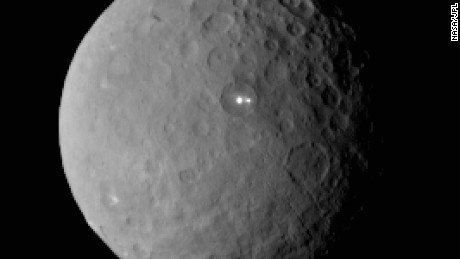
If that’s not immediately gripping, there is a bit of genuine mystery to pique your curiosity. Photos of Ceres from far away show two bright spots that appear almost reflective in nature and can be downright eerie given Ceres’ total isolation in the blackness of space. This yet unidentified geographical feature could be an example of cryovolcanism, a process that results in ice volcanoes that spew compounds of water and methane instead of molten rock. A slightly more mundane explanation is simply that a small portion of the icy core has broken through to the surface, hence the bright, reflective spot on an otherwise rocky façade. Whatever the reason, these are types of questions that can’t be answered with telescopes from Earth or mathematics calculations of what could hypothetically be expected to happen on a body such as Ceres. With our limited ability to transport human beings to other worlds, missions like this are currently our best option for getting a first-hand look at alien worlds and evidence of how they actually came to be.
 Before I leave you today, I’d like to return to the image of those two bright spots on Ceres, two bright eyes staring back like the glowing tapetum lucidum of a lion caught by the flash of a camera. This is more than just a new, memorable image from space. This is the man on the moon, the face we’ve seen for centuries before we brought a man up to meet him. This is the face on Mars, or the countless other strange shapes that humans have tried to ascribe meaning to as we sift through new photographs from these distant worlds. This phenomena is a type of pareidolia, the human inclination to find order and recognizable patterns where there is none, especially in the case of anthropomorphizing things. This can be attributed to an evolutionary need for self-preservation; if your mind is accustomed to finding the face of a predator amongst the jungle foliage, then you might have a leg up when there actually is a predator skulking there. In some ways, I don’t think much has changed. As we gaze upon these alien worlds, we look for the little pieces of relatable humanity. It helps keep us grounded as we ponder the enormity of the unexplored universe that awaits us.Then again, maybe these worlds are not so foreign after all. Perhaps it is our inexorable connection with all of the cosmos that spurs us forward to each new discovery.
As we look forward to what can be learned from observing Ceres, ponder for just a moment the words of Carl Sagan from Cosmos: A Personal Voyage: “Some part of our being knows this is where we came from. We long to return. And we can. Because the cosmos is also within us. We’re made of star-stuff. We are a way for the cosmos to know itself.”
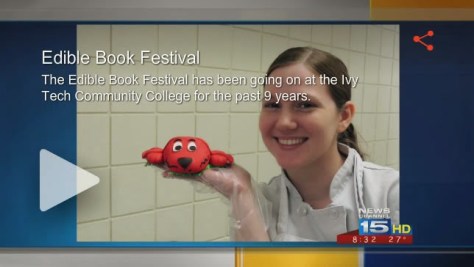
An interview with Library Director, Diane Randall and Librarian Sarah Ellsworth-Hoffman aired on WANE TV, March 7th, 2015.
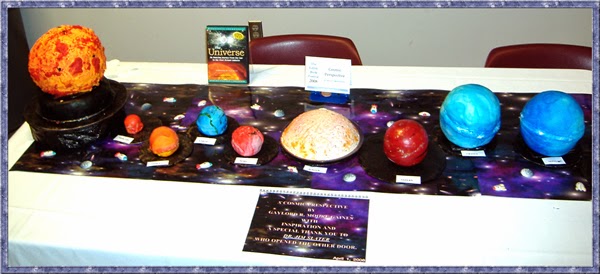 |
| Cosmic Perspective by Gaylord Moore (EBF 2008) |
What is the Ivy Tech Edible Book Festival?
This Edible Book Festival is hosted by the Ivy Tech Community College Northeast Library.
It will be held on Monday March 30th 2015. The festival is free and open to Ivy Tech students, employees, and the general public! Festival will start at 12pm and end at 2pm.
This is an event that unites bibliophiles, book artists, and food lovers across the world.The Edible Book Festival is a yearly event that takes place on or around April 1st throughout the world. Participants create edible books that are exhibited, documented then consumed by festival attendants. They show off their culinary creativity by making a dish based on a book or a pun of a book title.
The first Edible Book Festival was created by Judith A. Ho berg and Beatrice Coron in 2000, and has since been celebrated by libraries, bookstores, and other book lovers in over a dozen countries.
The Ivy Tech Library encourages you to register to create an entry or to just come and enjoy the awesome edible art. Many of our entries are made by Ivy Tech Hospitality’s Advance Cake decorating class. We also have entries from local businesses and food artists.
We will have refreshments, live music, crafts for kids and kids-at-heart, prizes, and literary entertainment.
Schedule of Events
11am : Set up time for Participants who made an “edible book” for the festival.
12pm – 1pm : Viewing of Edible Books. Live Music from the Ivy Tech House Band. Refreshments available.
12:15 – 12:50 : Crafting for Kids and Kids-at-Heart.
12:50 : Announcements and Acknowledgements.
1pm – 2pm : Eating of Edible Books.
1:30 – 2pm : Literary readings and Storytelling for all ages by Ivy Tech Administration.
Festival Attendees Choose their favorite entry and register for prizes!
Near the Refreshments table, festival participants will be able to vote for their favorite edible book entry. They can also sign up for prizes provided by the Ivy Tech Library.
Voting and prize sign up will need to be completed by 12:45pm.
Where is the Ivy Tech Edible Book Festival?
It will be held on Ivy Tech’s North Campus in the Student Life Center Gymnasium.
Once again Ivy Tech Library made books come to life through amazing creativity and delicious foods. Our 8th Annual Edible Book Festival was an absolute success, entertaining spectators and participants alike. Some pictures made it to the Metro section cover page of the Journal Gazette! Colors, delicious foods, fantastic ideas, smiles and conversations were flowing in the hallways of the Student Life Center for more than three hours. 31 participants included Ivy Tech students and staff, as well as outside businesses and colleges. Have a look at the festivities in the slideshow below. Remember, Ivy Tech library is your on-campus home – for help and resources, a place to rest, and even entertainment and occasional food is provided free of charge and with a lot of love and care! So next time you pass by the Library, come in and see for yourself. And we hope to see you next year for our Edible Book Festival!



It is now possible to print from your personal Windows laptop to Library printer FW-CC1771-lib2 by installing the Pharos software.

Disclaimer: All software is installed at your own risk. Due to the wide variety of settings and configurations possible on personal laptops, we cannot guarantee that wireless printing will work on all laptops. If you follow all the correct procedures to print, but printing does not work, the Bursar’s office will NOT reimburse you for your printing costs.
For more information click here.
|
JSTOR Adds Hebrew Language Journals In December 2013, JSTOR announced the Hebrew Journals Collection, which will add at least 40 Hebrew-language titles to JSTOR by completion. The collection culminates JSTOR’s collaboration with the National Library of Israel and the University of Haifa Library. It also builds upon a free pilot program for four Hebrew-language journals begun in 2008. Hebrew journals are fully integrated and searchable on the JSTOR platform, with added support for Hebrew content including right-to-left reading for Hebrew articles. This is the first collection of journals in a non-Roman language on JSTOR, and expands JSTOR’s efforts to add global scholarship to the platform. Read the full press release for more on Hebrew Journals. |
Arts & Sciences XIII Expands Global Humanities Content Launching in April, the Arts & Sciences XIII Collection will add 125 new journals to JSTOR in foundational humanities fields. More than 60 percent of titles in the collection are published outside of the United States. Core disciplines in the collection include Religion, Language & Literature, Philosophy, and Art & Art History. Notable titles in the collection include Literature and Theology (Oxford University Press), the Journal of Indian Philosophy (Springer Science + Business Media), and the Journal of Korean Religions (Institute for the Study of Religion at Sogang University, South Korea). Want more on Arts & Sciences XIII? Contact participation@jstor.org. |
The Edible Book Festival is an annual event that unites bibliophiles, book artists, and food lovers across the world. Participants show off their culinary creativity by creating an edible book- a dish based on a book or a pun of a book title. These are put on display and then consumed by festival attendants. Ivy Tech Library’s festival is free and open to Ivy Tech students, employees, and the general public—so invite a friend! The first Edible Book Festival was created by Judith A. Hoffberg and Beatrice Coron in 2000, and has since been celebrated by libraries, bookstores, and other book lovers in over a dozen countries.
It will be held on Monday, April 7th, 2014 in the hallways of the Student Life Center, which is located on Ivy Tech’s North Campus in Fort Wayne (3701 Dean Drive). Set up Entries: 11am – 12pm . View Entries: 12pm to 1pm. Taste Entries: 1pm to 2pm
To display your own edible book in the Festival, complete a registration form by Thursday, March 13th, 2014. Anyone can enter this event! The more the yummier! All participants will receive a $10 gift card as a “Thank You”. Also any participating artist or business is welcome to display business cards with their entry.


 Fort Wayne & Warsaw Library Blogs
